Which part(s) of the course was MOST valuable to you. Please explain why.
The checklist is dope.
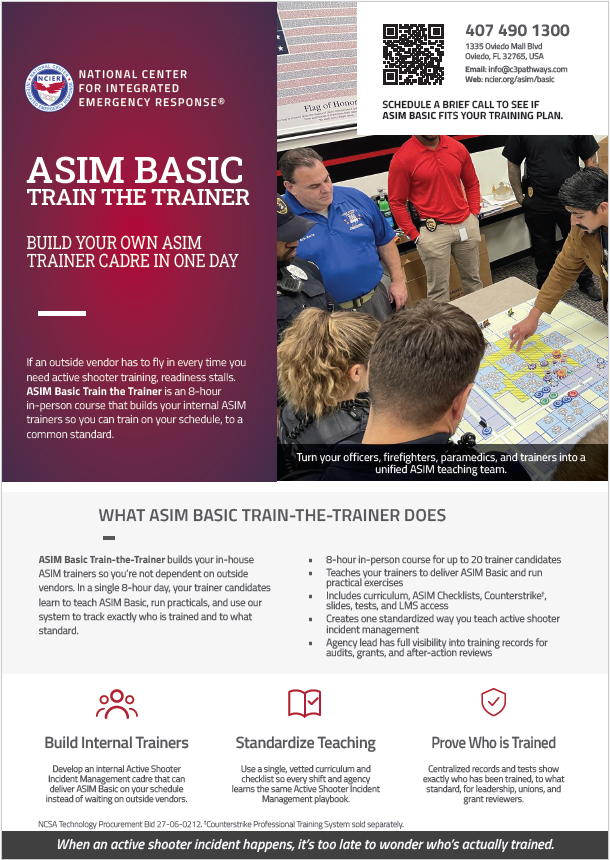
If an outside training provider has to fly in every time you need active shooter training, readiness stalls. ASIM Basic Train‑the‑Trainer is an 8‑hour in‑person course that builds your internal ASIM trainers so you can train on your schedule, to one standard ASIM playbook across law, fire, and EMS.
Most agencies have a patchwork of active shooter training that changes every time a new outside training provider shows up. ASIM Basic Train-the-Trainer builds a single internal ASIM trainer team so every shift, station, and mutual aid partner learns the same checklist‑based incident management model. Your leaders get a common playbook and clear, defensible training records.
Use one vetted ASIM Basic curriculum and checklist so every officer, firefighter, and medic learns the same incident management process.
Stop waiting on outside calendars. With in‑house trainers, you can run ASIM Basic for new hires, promotions, and refreshers whenever your schedule and staffing allow.
Centralized tests and training records show exactly who has completed ASIM Basic and when — for leadership, unions, grants, and after‑action reviews.
ASIM Basic Train-the-Trainer is a single 8‑hour in‑person course for up to 20 trainer candidates drawn from law enforcement, fire, and EMS. Over the day, your candidates experience ASIM Basic as students, then step into the trainer role to teach modules, run practical exercises, and use the system that tracks who is trained and to what standard.
Trainer candidates take part in the ASIM Basic course, walking through the checklist, case examples, and guided practicals from the student perspective.
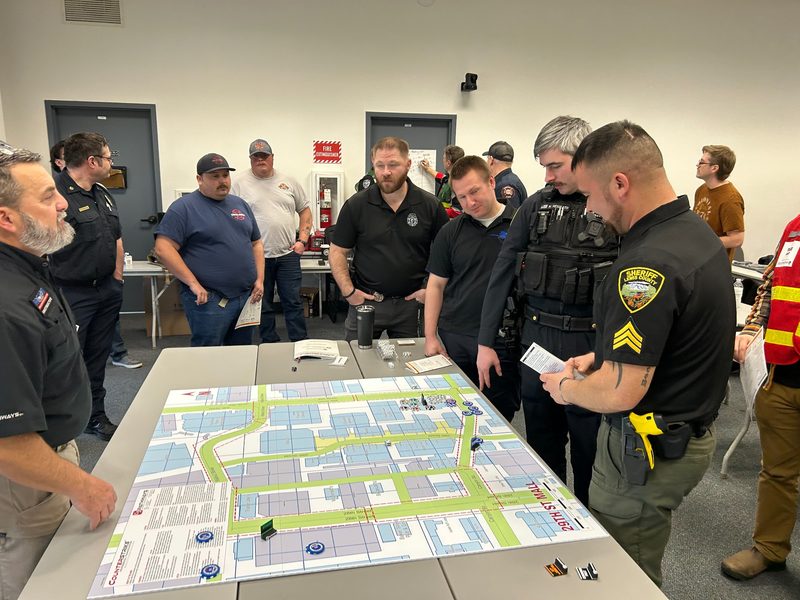
Candidates practice teaching key blocks, running Counterstrike™ practicals, giving feedback, and using the LMS to enroll students, score tests, and document training.
ASIM Basic Train-the-Trainer gives your people hands‑on confidence to both run ASIM Basic and answer hard questions from the line. Candidates leave having run scenarios, briefed mixed‑discipline groups, and seen exactly how the checklist performs under pressure.
Law enforcement, fire, and EMS trainer candidates work together so your ASIM trainer team reflects the way you actually respond.
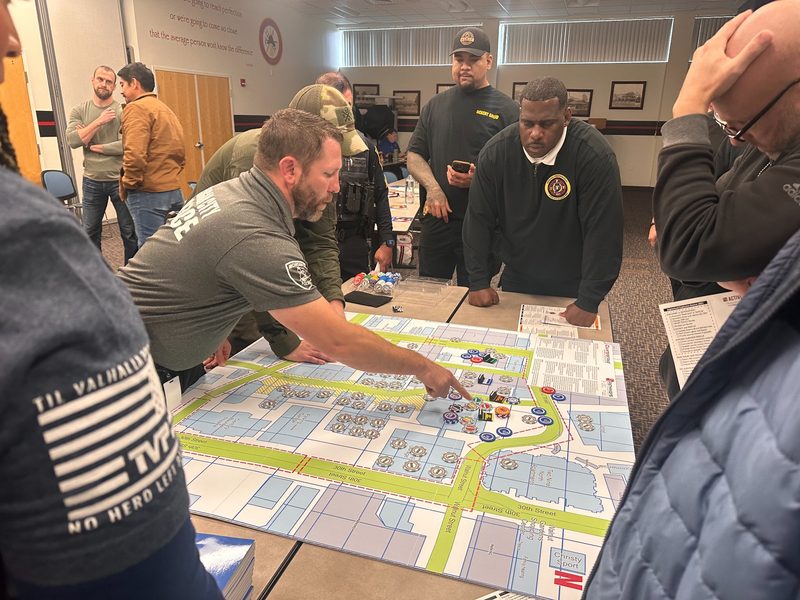
Candidates use the Counterstrike™ Professional Training System to walk through active shooter and hostile event scenarios from first call to last transport.
Each candidate gets reps presenting course content, facilitating practicals, and debriefing exercises — with coaching from NCIER instructors.
We use a no‑fault coaching style that supports both seasoned instructors and first‑time trainers, keeping the focus on learning the ASIM model and how to teach it.
You keep the full ASIM Basic curriculum and tools so you can deliver internal ASIM Basic training as often as needed — with no per‑delivery training fee from NCIER for non‑commercial use.
Bring your future ASIM trainers into one room and leave with a unified team.
Hosts provide the training space, basic AV, and up to 20 trainer candidates from law enforcement, fire, and EMS. NCIER provides the ASIM Basic curriculum, instructor team, and all course materials.
Here’s what happens over the next 1 business day.
Keep an eye out for a call from (407) 490-1300. If you don’t hear from us within 1 business day, call us at (407) 490-1300.
Prefer to talk now? Call (407) 490-1300.
ASIM Basic Train-the-Trainer is the step that turns ASIM from a one‑time class into a sustained standard across your agency.
15–20 minutes, no obligation. We’ll help you figure out if hosting ASIM Basic Train-the-Trainer makes sense for your agency.
Schedule a Brief CallWhich part(s) of the course was MOST valuable to you. Please explain why.
The checklist is dope.
Which part(s) of the course was LEAST valuable to you? Please explain why.
Breaks?.
Please provide any other comments or suggestions you have for improving this course.
It was good.
What other training is most important to you now that you have completed this course?
Same as before.
Which part(s) of the course was MOST valuable to you. Please explain why.
Being in the hot seat as triage supervisor.
Which part(s) of the course was LEAST valuable to you? Please explain why.
Standing around waiting to be dispatched (I was ambulance 3 to first two rounds).
Please provide any other comments or suggestions you have for improving this course.
Thank you all!.
What other training is most important to you now that you have completed this course?
RMCC training, local scenarios.
Which part(s) of the course was MOST valuable to you. Please explain why.
Tabletop exercises.
Which part(s) of the course was LEAST valuable to you? Please explain why.
None.
Please provide any other comments or suggestions you have for improving this course.
Good course, a lot of information in a short time, timeframe kept me interested through the whole course.
What other training is most important to you now that you have completed this course?
Furthering my knowledge of incident management, especially relayed to MCIs.
Which part(s) of the course was MOST valuable to you. Please explain why.
Student did not leave a written comment.
Which part(s) of the course was LEAST valuable to you? Please explain why.
Student did not leave a written comment.
Please provide any other comments or suggestions you have for improving this course.
Student did not leave a written comment.
What other training is most important to you now that you have completed this course?
Student did not leave a written comment.
Which part(s) of the course was MOST valuable to you. Please explain why.
Student did not leave a written comment.
Which part(s) of the course was LEAST valuable to you? Please explain why.
Student did not leave a written comment.
Please provide any other comments or suggestions you have for improving this course.
Student did not leave a written comment.
What other training is most important to you now that you have completed this course?
Student did not leave a written comment.
Which part(s) of the course was MOST valuable to you. Please explain why.
Student did not leave a written comment.
Which part(s) of the course was LEAST valuable to you? Please explain why.
Student did not leave a written comment.
Please provide any other comments or suggestions you have for improving this course.
Student did not leave a written comment.
What other training is most important to you now that you have completed this course?
Student did not leave a written comment.
Which part(s) of the course was MOST valuable to you. Please explain why.
The multiple iterations of the simulation. Each was slightly different and reinforced the concepts.
Which part(s) of the course was LEAST valuable to you? Please explain why.
N/a I thought it was all good. Not really any fat to trim.
Please provide any other comments or suggestions you have for improving this course.
Before the first simulation started, we should gone a little more in depth of the mechanics of the sim. As in how the chips work and how the vehicle worked. Also how the engines and ambos were organized. There were people off to the side who knew what role they were but not which truck.
What other training is most important to you now that you have completed this course?
The resource management aspect of which hospital has how many open beds etc.
Which part(s) of the course was MOST valuable to you. Please explain why.
The table top exercises which put the presentations into practice.
Which part(s) of the course was LEAST valuable to you? Please explain why.
N/A.
Please provide any other comments or suggestions you have for improving this course.
N/A.
What other training is most important to you now that you have completed this course?
Continuing this type of training to better myself.
Which part(s) of the course was MOST valuable to you. Please explain why.
Learning another model for management of an event.
Which part(s) of the course was LEAST valuable to you? Please explain why.
Response would be much different in rural areas. Maybe only 5 officers and less responders then in a metro area like madison.
Please provide any other comments or suggestions you have for improving this course.
Student did not leave a written comment.
What other training is most important to you now that you have completed this course?
Staying up to date on current best practices.
Which part(s) of the course was MOST valuable to you. Please explain why.
Tabletop exercises.
Which part(s) of the course was LEAST valuable to you? Please explain why.
N/A.
Please provide any other comments or suggestions you have for improving this course.
Great course, I was able to learn a lot.
What other training is most important to you now that you have completed this course?
Student did not leave a written comment.
*Evaluations are collected from verified course participants and published without editing. Ratings and comments reflect each participant’s individual experience.