Which part(s) of the course was MOST valuable to you. Please explain why.
The most valuable part for me was doing multiple practicals.
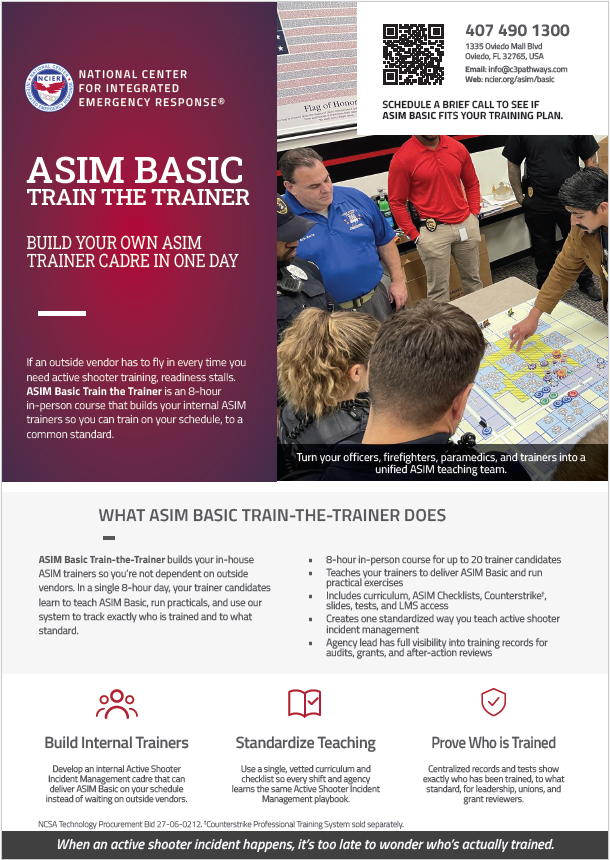
If an outside training provider has to fly in every time you need active shooter training, readiness stalls. ASIM Basic Train‑the‑Trainer is an 8‑hour in‑person course that builds your internal ASIM trainers so you can train on your schedule, to one standard ASIM playbook across law, fire, and EMS.
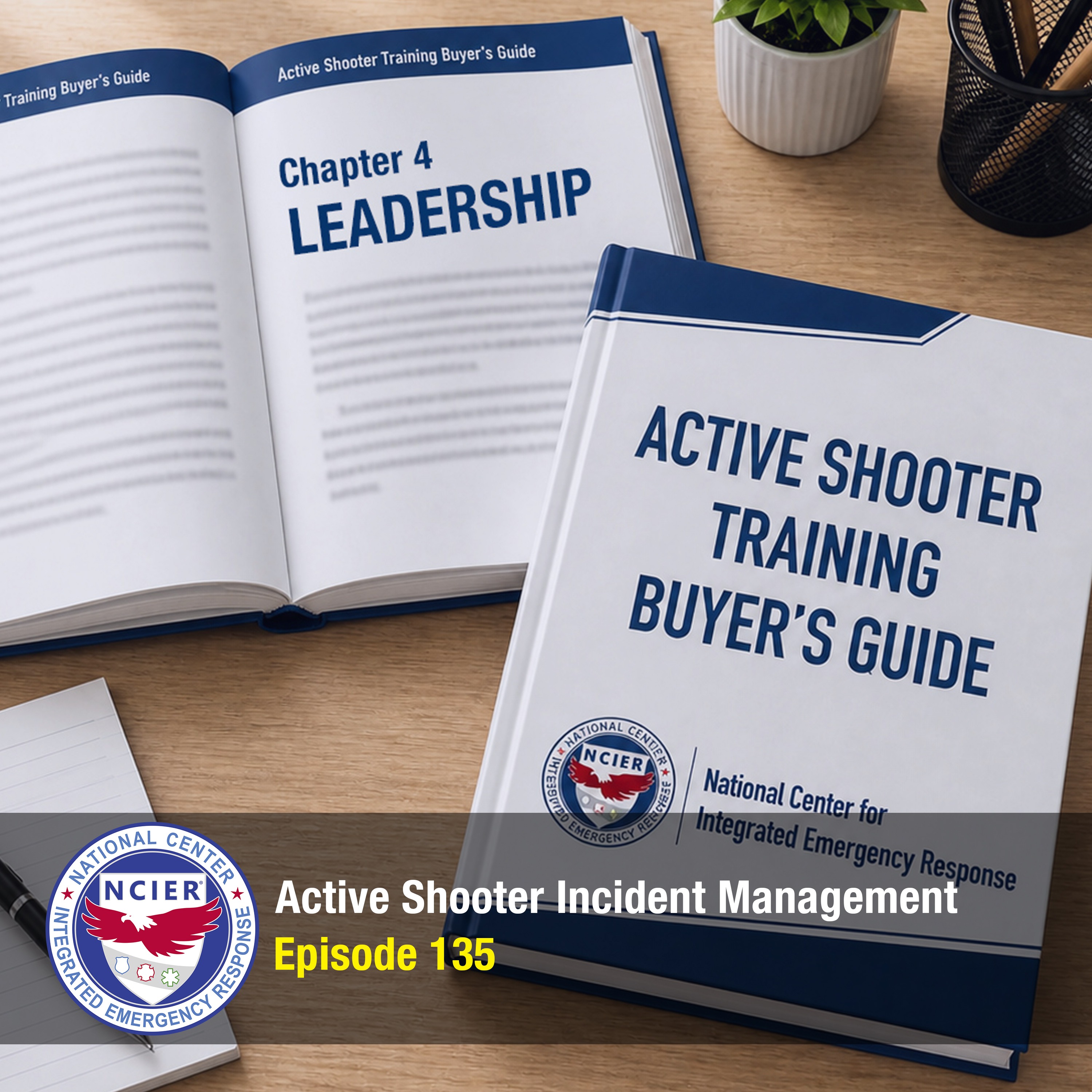
Most agencies have a patchwork of active shooter training that changes every time a new outside training provider shows up. ASIM Basic Train-the-Trainer builds a single internal ASIM trainer team so every shift, station, and mutual aid partner learns the same checklist‑based incident management model. Your leaders get a common playbook and clear, defensible training records.
Use one vetted ASIM Basic curriculum and checklist so every officer, firefighter, and medic learns the same incident management process.
Stop waiting on outside calendars. With in‑house trainers, you can run ASIM Basic for new hires, promotions, and refreshers whenever your schedule and staffing allow.
Centralized tests and training records show exactly who has completed ASIM Basic and when — for leadership, unions, grants, and after‑action reviews.
ASIM Basic Train-the-Trainer is a single 8‑hour in‑person course for up to 20 trainer candidates drawn from law enforcement, fire, and EMS. Over the day, your candidates experience ASIM Basic as students, then step into the trainer role to teach modules, run practical exercises, and use the system that tracks who is trained and to what standard.
Trainer candidates take part in the ASIM Basic course, walking through the checklist, case examples, and guided practicals from the student perspective.
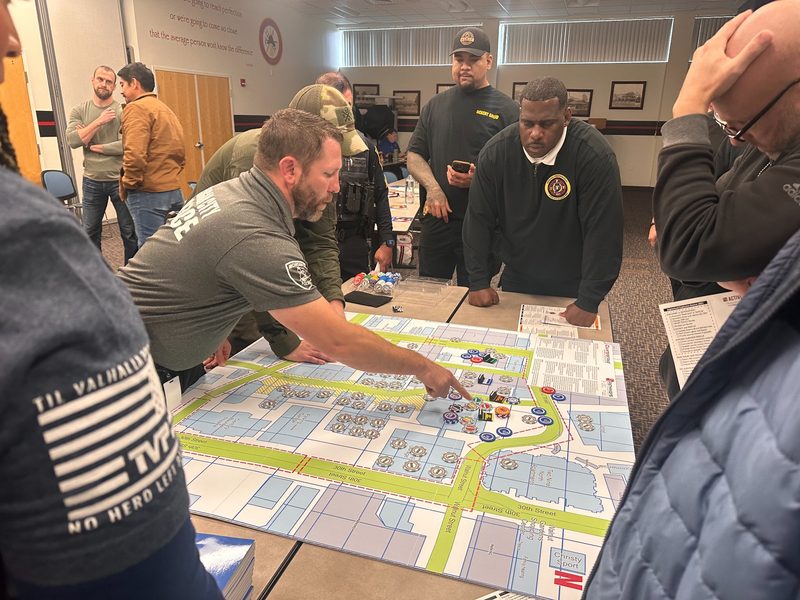
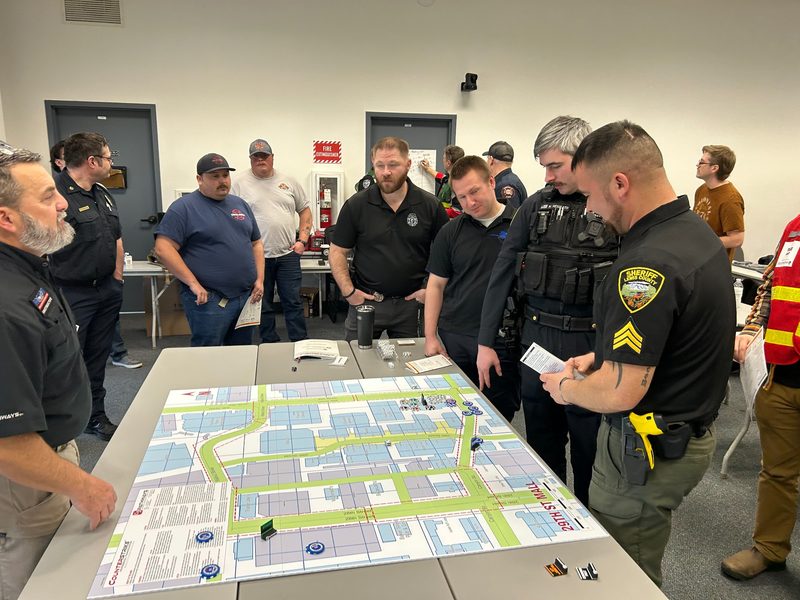
Candidates practice teaching key blocks, running Counterstrike™ practicals, giving feedback, and using the LMS to enroll students, score tests, and document training.
ASIM Basic Train-the-Trainer gives your people hands‑on confidence to both run ASIM Basic and answer hard questions from the line. Candidates leave having run scenarios, briefed mixed‑discipline groups, and seen exactly how the checklist performs under pressure.
Law enforcement, fire, and EMS trainer candidates work together so your ASIM trainer team reflects the way you actually respond.
Candidates use the Counterstrike™ Professional Training System to walk through active shooter and hostile event scenarios from first call to last transport.
Each candidate gets reps presenting course content, facilitating practicals, and debriefing exercises — with coaching from NCIER instructors.
We use a no‑fault coaching style that supports both seasoned instructors and first‑time trainers, keeping the focus on learning the ASIM model and how to teach it.
You keep the full ASIM Basic curriculum and tools so you can deliver internal ASIM Basic training as often as needed — with no per‑delivery training fee from NCIER for non‑commercial use.
Bring your future ASIM trainers into one room and leave with a unified team.
Hosts provide the training space, basic AV, and up to 20 trainer candidates from law enforcement, fire, and EMS. NCIER provides the ASIM Basic curriculum, instructor team, and all course materials.
Here’s what happens over the next 1 business day.
Keep an eye out for a call from (407) 490-1300. If you don’t hear from us within 1 business day, call us at (407) 490-1300.
Prefer to talk now? Call (407) 490-1300.
ASIM Basic Train-the-Trainer is the step that turns ASIM from a one‑time class into a sustained standard across your agency.
15–20 minutes, no obligation. We’ll help you figure out if hosting ASIM Basic Train-the-Trainer makes sense for your agency.
Schedule a Brief CallWhich part(s) of the course was MOST valuable to you. Please explain why.
The most valuable part for me was doing multiple practicals.
Which part(s) of the course was LEAST valuable to you? Please explain why.
N/A.
Please provide any other comments or suggestions you have for improving this course.
Having 2-3 blocks on this course.
What other training is most important to you now that you have completed this course?
Understanding how to respond to an active shooter event.
Which part(s) of the course was MOST valuable to you. Please explain why.
Student did not leave a written comment.
Which part(s) of the course was LEAST valuable to you? Please explain why.
Student did not leave a written comment.
Please provide any other comments or suggestions you have for improving this course.
Student did not leave a written comment.
What other training is most important to you now that you have completed this course?
Student did not leave a written comment.
Which part(s) of the course was MOST valuable to you. Please explain why.
The practical exercise that we did in the class as platoon. I learned alot, better understanding the whole concepts of the event, and everyone had their own role.
Which part(s) of the course was LEAST valuable to you? Please explain why.
Alot of information to capture in short period of time. Need more time to learn all the operation procedures.
Please provide any other comments or suggestions you have for improving this course.
More practice exercises, scenarios, and bigger learning environment.
What other training is most important to you now that you have completed this course?
How to response to Active Shooter Event and prepare for the operation.
Which part(s) of the course was MOST valuable to you. Please explain why.
The practical because it puts you in a potential real world scenario where you can utilize this course to the best of your abilities.
Which part(s) of the course was LEAST valuable to you? Please explain why.
N/A. The entire course was of value.
Please provide any other comments or suggestions you have for improving this course.
N/A.
What other training is most important to you now that you have completed this course?
More training in Active Shooter incidents to help improve my role if I were to be in an active shooter situation.
Which part(s) of the course was MOST valuable to you. Please explain why.
The practical exercises allowed for hands on learning, which, for myself, allows the information to be learned better.
Which part(s) of the course was LEAST valuable to you? Please explain why.
None.
Please provide any other comments or suggestions you have for improving this course.
Student did not leave a written comment.
What other training is most important to you now that you have completed this course?
Student did not leave a written comment.
Which part(s) of the course was MOST valuable to you. Please explain why.
The live simulations were advanced but very beneficial to put presentation into a real life scenario.
Which part(s) of the course was LEAST valuable to you? Please explain why.
The moving parts in the scenario moved quickly with lots of moving parts which in the short amount of time was a challenge to grasp.
Please provide any other comments or suggestions you have for improving this course.
This course was excellent, perhaps a slower break down of the first example of the scenario could’ve made it easier to understand the moving parts.
What other training is most important to you now that you have completed this course?
Learning how to clear a building and provide the triage is of upmost importance in responding to an active shooter.
Which part(s) of the course was MOST valuable to you. Please explain why.
Learning new material.
Which part(s) of the course was LEAST valuable to you? Please explain why.
Nothing it was all important information.
Please provide any other comments or suggestions you have for improving this course.
Engage the class in more participation.
What other training is most important to you now that you have completed this course?
Scanning a room that is unknown what is inside.
Which part(s) of the course was MOST valuable to you. Please explain why.
The helpfulnesss of the instructors was most valuable because it encouraged me to ask questions.
Which part(s) of the course was LEAST valuable to you? Please explain why.
The radio transmission audio was difficult to follow.
Please provide any other comments or suggestions you have for improving this course.
I thought the class was very informative.
What other training is most important to you now that you have completed this course?
All training involving active response to threats or people with weapons I think are the most important.
Which part(s) of the course was MOST valuable to you. Please explain why.
Student did not leave a written comment.
Which part(s) of the course was LEAST valuable to you? Please explain why.
Student did not leave a written comment.
Please provide any other comments or suggestions you have for improving this course.
Student did not leave a written comment.
What other training is most important to you now that you have completed this course?
Student did not leave a written comment.
Which part(s) of the course was MOST valuable to you. Please explain why.
The practical event. It put words from the lecture to life in helping me understand the content.
Which part(s) of the course was LEAST valuable to you? Please explain why.
The lecture. I learn better hands on so the lecture didn't stick to memory as well as the practical did.
Please provide any other comments or suggestions you have for improving this course.
I thought the course was run great the way it was.
What other training is most important to you now that you have completed this course?
To continue to go to training events as more knowledge is more power when using a course like this in a real life scenario.
*Evaluations are collected from verified course participants and published without editing. Ratings and comments reflect each participant’s individual experience.