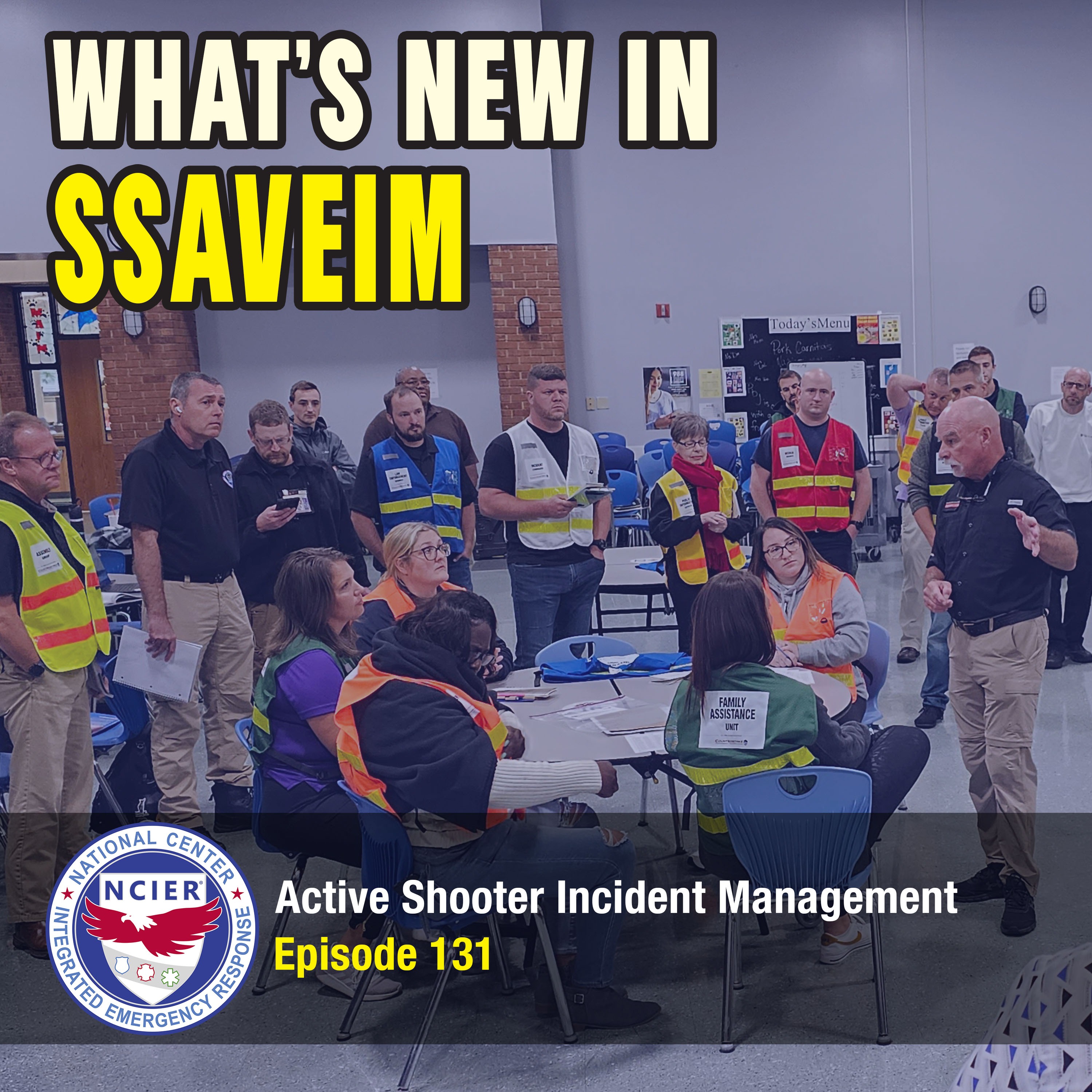
Transcript
Welcome everyone. Today I want to address a question that comes up frequently in our training and that I recently got from a police chief who was drilling in to the active shooter incident management checklist. His question was simple and direct. When exactly do we transition from a single incident commander to a unified command? What's the trigger point?
It's a great question and the answer is more nuanced than you might expect. Hello, my name is Bill Godfrey. I'm an instructor with the National Center for Integrated Emergency Response. And over the next few minutes, I'm going to walk you through not just the when, but the why behind how we approach unified command in active shooter and hostile event incidents.
To answer the chief's question point blank, there is no specific transition time. There's no checkbox on the checklist that says, "At minute 12, switch to unified command." It depends very much on the jurisdiction, whether you're metro, urban, suburban, or rural, and particularly on the staffing of executive level leadership. The day of the week and time of day also play a significant role. A suburban jurisdiction responding to an incident on a Wednesday at 10 a.m. is likely to get a reasonably quick response of executive leadership to the scene. That same jurisdiction in the middle of the night or on a weekend is going to see a significant delay. Now contrast that with a metro organization that likely has executive leadership on duty 24-7 with a much more predictable response time. So the transition happens when the right people are in place and ready, not at a predetermined time.
Let me define what I mean by executive leadership because this is important. We're talking about individuals who have the authority to make policy decisions and speak for their agency. Because the use of rank varies so much across organizations and disciplines, you can't really rely on rank alone. Generally, we're talking about chiefs, deputy chiefs, assistant chiefs, and equivalents. And when you bring non-public safety agencies into the command post, a school district representative, a hospital administrator, a city manager. Those ranks don't apply at all. These are the people who need to be present to form a unified command. A suburban jurisdiction on a Wednesday morning might have these folks available within 15 to 20 minutes. That same jurisdiction at 2 a.m. on a Saturday, you might be waiting 45 minutes or more. A large metro agency with 24-7 executive coverage might have someone on scene in under 10 minutes. All of these variables affect when Unified Command can realistically stand up.
So what exactly is the job of Unified Command? The Unified Command team primarily addresses community impact and policy decisions around the incident, and provides strategic direction and objectives to the Operations Section Chief. This is a critical distinction. Unified Command is not there to run the tactical operation. They're setting the strategic direction. For example, what are our priorities? What resources are we authorizing? What policy decisions need to be made about evacuations, school closures, notifications, press conferences, mutual aid requests, and more? The operational execution stays with the Operations Section Chief. This separation of strategic and tactical responsibility is what makes the system work at scale. When Unified Command tries to do both, set strategy and run tactics, everything slows down and the system breaks.
Here is the key mechanism that makes this work. When Unified Command stands up, the initial incident commander transitions to become the operations section chief. This accomplishes something incredibly important. It all but eliminates operational disruption. Think about it. The initial IC already has situational awareness. They've been running the response. They know where the contact teams are. They know the status of the rescue task forces. They know the threats. They know the building layout from what's been reported. All of that remains unchanged. The initial incident commander just shifts from being the IC to being the Ops Chief, continuing to execute the tactical operation with everything they already know. Meanwhile, the newly formed Unified Command takes over the strategic and policy level decisions. No one is starting from scratch. No one is losing situational awareness. And the response doesn't skip a beat.
When unified command was originally added to ICS decades ago, there was always an expectation that a unified command would speak with one voice. If Ops was not established, then one of the unified commanders was selected to be the one voice providing direction. This was purposefully designed to avoid confusing or contradictory command orders. All of this used to be codified in the NIMS ICS standards. But over the years, scope creep has turned unified command into something different in practice. Many agencies now operate under a model where the law enforcement leader commands law enforcement, the fire leader commands fire, and the EMS leader commands EMS, and so on. And I want to be clear, this model works fine for small incidents and can be quite effective. But it does not scale to large, fast-moving critical incidents. Through exercises and training, we found that using this each leader commands their own discipline model in active shooter incidents introduces confusion, creates bottlenecks at the command post level, and slows the overall response. The original one voice through operations model is what works at scale for large complex fast moving incidents.
It might surprise many of you to know when we first developed the active shooter incident management checklist, we advocated strongly for immediate unified command by the very first arriving supervisors. What we found through exercises and training is that while it worked, it was slow and not a little slow, very slow, especially in the first 10 to 20 minutes. The slowness was compounded by trying to build out the management team by plugging each arriving supervisor into a key ICS position under unified command. Each new supervisor needed six to eight minutes on average to gain situational awareness before they could effectively execute their role. This delay multiplied with each person inserted. What I'm describing is a top-down driven view of ICS, which is essentially the fire service model. A fire chief can stand on the sidewalk looking at a burning building and know what's going on by reading the smoke, flames, and conditions. The chief can call the play from the command post. In an active shooter event, the IC on the sidewalk doesn't know anything about what's happening inside the building other than what's reported. The responders inside know what's going on, and they must communicate up. Law enforcement needs a bottom-up-driven ICS model. Top-down will work, it's just slower. And that is what we found the hard way, which is why we changed.
For all of these reasons, we strongly advocate for law enforcement-led incident command right from the beginning. After all, this is a murder in progress. The very first arriving law enforcement officer establishes command as Contact Team 1 until the fifth man arrives and assumes command as tactical. The first arriving law enforcement supervisor takes command from tactical and establishes the command post. And that first arriving law enforcement supervisor ultimately becomes the law enforcement branch after turning over command to the second arriving law enforcement supervisor. They are joined by the first fire EMS supervisor who assumes the role of medical branch. And they all run the show until the executive leadership from the involved disciplines can arrive on scene, get a detailed face-to-face briefing from the IC, and then formally establish unified command with the previous IC moving to the operations section chief role. This approach gives you speed from the start, maintains operational continuity through the transition, preserves situational awareness, and puts the strategic policy decisions where they belong, with the executives who have the authority to make them.
The transition to unified command isn't a checkbox or a time hack. It's an event that occurs when the right people are in place and ready to add value at the strategic level without disrupting the tactical operation that's already underway.
At the end of the day, our goal is simple. The fastest way to neutralize the threat and rescue the injured, so responders can save every saveable life. Every decision we make about command structure, about when to transition to unified command, about who goes where, it all serves that goal. We are always looking for feedback and constantly reevaluating how we do things. If you have questions about what we covered today or want to discuss how this applies to your jurisdiction, we're available at any time. You can reach us at the National Center for Integrated Emergency Response at ncier.org. Thank you.