
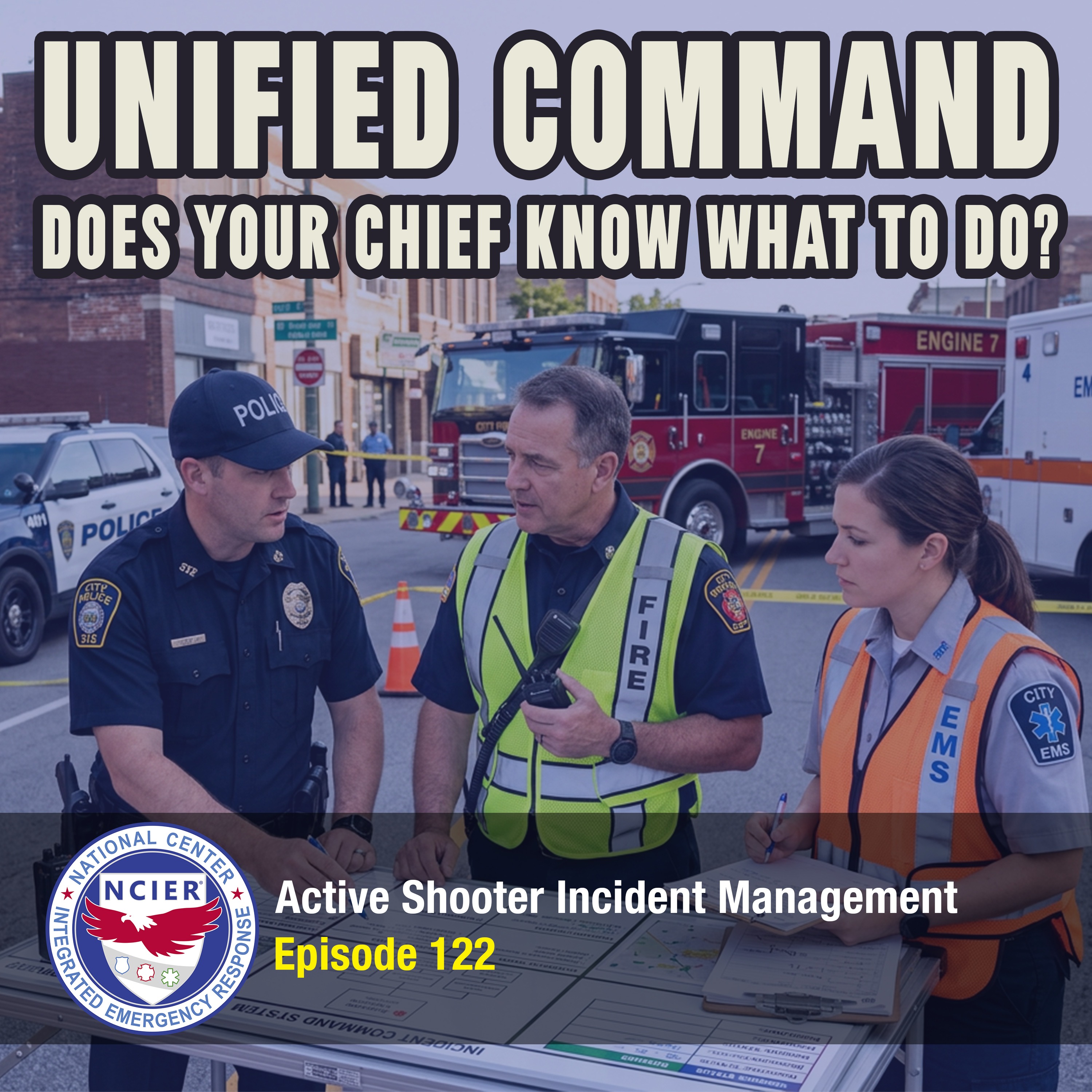
Ep 122: Unified Command - Does Your Chief Know What To Do?
Episode 122
Published Apr 13, 2026
Last updated Apr 14, 2026
Duration: 28:08
Episode Summary
When is the right moment to shift from a single law enforcement incident commander to unified command in an active shooter event—and how do you do it without slowing everything down? In this episode, we unpack the real-world factors that drive that decision, what unified command should focus on, and how to avoid creating confusion or delays when executives arrive on scene. For a deeper dive into the key concepts, be sure to check out the companion article and video on our website.
Episode Notes
When do you move from a single law enforcement incident commander to a unified command in an active shooter event—and how do you do it without creating chaos at the command post? That is the question we dig into in this episode of the Active Shooter Incident Management Podcast.
Host Bill Godfrey sits down with Sheriff Kevin Beary and Assistant Police Chief Kevin Nichols from the National Center for Integrated Emergency Response to talk through real-world considerations that don’t show up on a checklist. They explore how jurisdiction size, time of day, staffing, and executive availability shape the “right time” to make the switch, and why the answer is more nuanced than a simple rule.
You’ll hear them unpack what unified command should actually be focused on, what “speaking with one voice” really means, and how to transition from that first law enforcement incident commander into a unified command structure without disrupting what’s already working in the field. Along the way, they share lessons learned about speed, situational awareness, and avoiding self‑inflicted delays.
If you’re a law, fire, or EMS leader—or someone likely to end up at the command post—this conversation will help you think through how your agency should approach unified command before the next major incident.
🔗 For a deeper dive on this topic, check out the companion pieces on our website:
- When Does One Leader Become a Team? Understanding Unified Command in Active Shooter Response
- When to Transition to Unified Command in an Active Shooter Incident
View this episode on YouTube at: https://youtu.be/aspgiNW8jzs
#ActiveShooterResponse #UnifiedCommand #IncidentManagementSystem #FirstResponders #LawEnforcementTraining #Podcast
Transcript
Bill Godfrey:We recently had a question come in from a police chief. Question was pretty simple. When exactly do you transition from the single incident commander to a unified command in an active shooter event? That's today's topic. Stick around.
Welcome to the Active Shooter Incident Management Podcast. My name is Bill Godfrey. I am being joined by two of my other instructors here at the National Center for Integrated Emergency Response. I have Sheriff Kevin Beary here with us. Good to have you back in, Sheriff.
Kevin Beary:
Always good to be here, Bill.
Bill Godfrey:
And we have assistant police chief Kevin Nichols in the house. Kevin, good to have you.
Kevin Nichols:
Thanks, Bill. Great to be here.
Bill Godfrey:
So, the question came in from a police chief that was attending one of our trainings and interacting with the team and he was really digging into the active shooter incident management checklist, had a bunch of great questions, but one of his questions was specifically, when do you transition from the single incident commander, who's a law enforcement incident commander, to a unified command team? He was really trying to understand that because there's a lot of doctrine out there that says you should do unified command right from the beginning. And we're going to talk a little bit about why we do it the way we do it.
But let's first talk about when do you actually transition to a unified command? Is there a magic number or a moment in time that you're supposed to do it?
Kevin Beary:
There is no magic number. There is no timeline on the checklist. It all depends on your all depends on your jurisdiction. You know, you could be a rural agency, a metro agency, suburban. It all depends on what you got for manpower and how you're going to deal with the incident.
Bill Godfrey:
And why does that matter? Because who are we looking to have on the unified command team?
Kevin Nichols:
You know, it's always your favorite question. Your favorite answer to get from an instructor when you ask a question in class is it depends, right? So, it does depend. And it depends because we're trying to get that executive level leadership in, that person who is responsible to speak for the agency and make decisions on that agency's behalf. And it can't just be from one side of the agency. You have to have your fire chief. You have to have your law enforcement chief. Your EMS chief. If it's a third party EMS or a third party EMS is involved, it could also possibly be somebody from the school district. If it's an attack at the school, you might want a superintendent or principal, senior ranking people from the school district or from the hospital if it's a hospital attack or the venue wherever this occurs. You're going to want those people in your unified command. So having them number one be on scene and ready and informed and ready to take over I think is important. The idea of when that could happen, like the sheriff was pointing out, would be different in Mayberry, USA than it might be in New York City.
Kevin Beary:
Kevin, can you use an emergency manager at that command post?
Kevin Nichols:
Absolutely you can use an emergency manager. They're going to be more of that support function. I don't think they would be in the decision maker role, but they would absolutely be there to support and help the incident commander or the unified command once it's set up.
Bill Godfrey:
Sheriff, you mentioned a moment ago that it depends on the size of the jurisdiction, rural, suburban, urban, metro areas. Why does that matter? Why does the size of the jurisdiction matter on when you go to unified command, make the transition?
Kevin Beary:
Well, if an incident happens during the daytime, Monday through Friday, you're going to be able to get executive leadership to the scene probably a little quicker than at 2:00 on a Saturday or Sunday morning. And that's just the way it is. That's just, that's life in general.
Bill Godfrey:
In your larger organizations that are very urbanized or are a metro organization, they tend to have that executive level leadership. Somebody is assigned to 24/7 shift coverage that's actually on duty at that executive level or at the very least maybe assigned to be on immediate call out at that executive level. But is that really, do we see that a lot? Is that common in the suburban and rural jurisdiction that you've got executive level decision-making on duty?
Kevin Beary:
The metro areas, yes, you'll have a watch commander or a high-risk incident commander, but on the, you know, smaller and rural agencies like where Kevin and I just came from teaching out in Nevada, you got a sergeant and four deputies. So, you're going to have to wait for that executive leadership to get on the scene.
Kevin Nichols:
I think the other thing to think about on that is at the larger agencies, you have a tendency to have more people who are qualified to fill that role. At the smaller agencies, you might only have a chief or a chief and an assistant chief that can fill that role. Whereas at the larger agencies, you're going to have probably multiple assistant and deputy chiefs who could step into that role. So, you have a larger pool to pull from to be able to fill that assignment.
Kevin Beary:
Bill, if I could, I like the fact that a chief is asking this question because I think it's very important for sheriffs, chiefs, assistant chiefs, high ranking officers of those agencies to attend this kind of training because if you've got the training and your people have the training, potentially it might run a whole lot smoother for you.
Bill Godfrey:
That's a very insightful point that I think what we're saying is the unified command team needs to be executive level leadership that has the authority to set policy and make decisions on behalf of the organization maybe even on behalf of the community and that's who we're looking to have on that unified command team.
All right. So, let's talk about what exactly is the mission of unified command. I think one of the things that often gets lost is people don't see the distinction between the role of what unified command is supposed to do, what their mission and their view is supposed to be versus that initial single incident commander and what their mission is. So let's talk a little bit about what is, in the context of an active shooter event, what is the mission of unified command.
Kevin Nichols:
So it's all the effects that happen to your jurisdiction that happen outside of the outer perimeter. So if you think about how are we going to respond to other events? How are we going to, are we going to make decisions about evacuating areas of the city? Are we going to make decisions about declarations of disasters? Are we going to make decisions about how we're going to staff, how we're going to backfill our staffs for the next several days? How are we going to support other possible attacks that happen outside of the incident command area?
Bill Godfrey:
Sheriff, what are your thoughts on this?
Kevin Beary:
Well, I think it's important that the law enforcement executive branch looks at the big picture. Are you getting that social media out to inform your citizens where the lockdowns are? You know, lock down in place. The school is closed. The reunification center is located here. We'll let you know when it is staffed and ready to be opened. The impacts regionally, whether it's going to impact transportation, airports, bus stations, and things like that. That's the big picture items that need to be discussed.
Kevin Nichols:
The other thing you're going to have is you're going to have a, at these type of incidents, you're going to have a large response from your not just your local, but you're also your state and federal level politicians. They're going to show up to offer assistance to try to help out and to assist their constituency. You don't want your incident commander having to deal with that. You don't want your op section chief having to deal with that. A unified commander, somebody who can speak for the city and the jurisdiction, needs to be liaisoning with those folks and coordinating the message out on the public information side and and making those determinations and helping with that to take it off the plate of the incident commander who's focusing on everything inside that outer perimeter.
Kevin Beary:
And that executive leadership team can really help the staging area working with dispatch to get the resources there so that when you need resources right then they can get them out to you.
Bill Godfrey:
One of the things we haven't touched on here yet is the emergency operations center. Now, in some jurisdictions, very forward thinking, the activation of the emergency operations center, notification of the emergency management or the emergency manager would be automatic. But in other jurisdictions, opening the emergency operations center is a big deal because it has a financial impact and that's left as an executive level decision. What's the goodness of the executive level team activating an emergency operations center in an incident like this?
Kevin Beary:
Well, I think when you activate an emergency operation center it is a serious incident and you have to make that decision to get it open because that provides you opportunities and staff to help you command that particular situation.
Kevin Nichols:
I think depending on the level, the size of your agency, and the number of resources you have available initially that emergency manager and that EOC can assist you greatly. We all need stuff and what you run into is a lot of times we go to smaller agencies and they're like you know what we don't have the manpower or the resources to deal with this type of event. One of our instructors has a great quote that I steal from him frequently is the problems don't go away based on the size of your agencies. The problems don't go away. You still have to face those problems. And the way you face that is through your emergency management, your EOC, by getting you resources. This is the United States of America. I can get you anything you want. It's just a function of time and money and knowing who to call. And that's your EOCC's problem.
Kevin Beary:
Totally agree with that.
Bill Godfrey:
Yeah, very well said.
So, one of the challenges that has crept in over the years is the drift or what what I'll call scope creep of what unified command has come to mean to the people on the streets. So, when unified command was originally dreamed up and became part of NIMS ICS doctrine, there was a requirement that you had to speak with one voice. You either had to have an operations chief that you ran things through or if you didn't, you would pick one of the unified commanders to be that one voice that would give orders to the troops. A lot of reasons for that to avoid contradictory orders, contradictory actions, all of that kind of thing.
How big a deal is it here to make sure that we're speaking with one voice? Because what's happened on the streets over the years and in fact there's even been some adoption of this in the ICS standards is that unified command has come to mean to the people on the streets that the law enforcement unified commander directs the law enforcement troops. The fire unified commander directs the fire troops and the EMS unified commander directs the EMS troops which violates this doctrine. Yet people will tell you very quickly, but it works. We use it all the time. But tell me from your perspectives, what are the issues of not speaking with one voice and why does it become so important?
Kevin Beary:
Well, this is a murder in progress. So, cut through the chase. Law enforcement's in charge. Fire and EMS are going to be there to help. And that's why we set it up with a, you know, the initial tactical person, fifth man is on the scene, then the first line supervisor and law enforcement, then the fire chief or his alternate. And that way you have the law enforcement branch and the medical branch set up. Then your incident commander comes in because if that is the way it's set up, it saves time. It streamlines the operation. It's getting things settled down where you can then transition to that unified command.
Kevin Nichols:
I think much like your air traffic control manual or your pilot's handbook or anything like this, those requirements are written in blood, right? There was a requirement for us to have a unified command because of a failure of having unified command and because it cost people blood and it cost people lives. We, like you mentioned, it's a scalable problem at the small level the everyday level the car crash or the garbage fire or the house fire even the small response problems can be solved with cops running cops fire running fire medics running medics. But at the large scale event if we're not on the same page coordinating and integrating at every level we're costing people their lives. We're giving alternate instructions. People may not be on the same page as to, you know, where they're going or what they're doing or what our priorities of work are. And then even longer term down the road, which is not maybe not necessarily as critical on the front end, is getting that that speaking with one voice to the media and to the public, right? How many times have we seen historically where there are false narratives that go out that become the story of that event even though they're false and not having the right information and one person speaking with one voice causes a lot of that.
Bill Godfrey:
The answer that I would give people is because it's a small incident because you don't have an overlapping integrated response need. In the case of an active shooter event, everyone has to rely on the other organizations to make this work. And in those instances, it's critically important to speak with one voice. In a fastmoving critical large incident, the unified commanders all issuing orders by discipline does not scale. It's stove pipes at the command post.
Now talk to me a little bit about the transition itself. So you've got your executive leadership. They've arrived on scene. They've gotten the briefing from your incident commander who's a law enforcement incident commander. They're ready to establish unified command. Walk me through that transition because when you make these command transitions, they can become very disruptive to the scene. Walk me through how to do it without the disruption.
Kevin Nichols:
So again, the idea as we kind of discussed the idea of having that law enforcement person as a solo incident commander early on because of the speed, because it's fast, we like having that. When we get our executive leadership in place and start working the problem. They getting the executive leadership in place. We don't want them coming in and taking over the tactical decisions on the scene. You've got people in place who have history on it, who understand the decisions that have been made and why those decisions were made and who is doing what underneath them. We want to take things off of their plate on the on the higher level. So the idea would be, the way we work things with the active shooter incident management checklist, is that incident commander, for the solo incident commander response, solo incident commander being in charge, falls into that ops section chief position and then the executive leadership command goes in over the top of him to help support him and resource him and set those strategic guidelines and objectives and then to help him be successful but not necessarily taking over his role and trying to re-manufacture the wheel.
Kevin Beary:
And I like that executive law enforcement team as well as the fire and EMS team coming together in that unified command because if they make that smooth transition from that incident commander becoming the ops chief and then they let's go right to the first media event. You got your PIO there. You got your fire chief. You got your EMS director. You got your law enforcement leader and it sends a message to the community. We got this under control. We are working together to rectify the problem and that's a positive thing and that's a very strong message to the community.
Bill Godfrey:
And I think the other thing that I would add to what both of you has offered is it's really critical not to allow that change of command to become disruptive to the operation. And the way to do that is, you know, Kevin, as you outlined, is to take that initial incident commander and make them the operations chief. Because literally the only thing that changed changed in the command post. The field nothing changes. They are still calling command or calling the command post and that ops chief is the one still there making those decisions, communicating with the law enforcement branch supervisor, with the medical branch supervisor and making those decisions. And so by doing it this way, you avoid allowing disruption, hiccups, delays from creeping into the operation that you are already neck deep in.
And the role of the unified command team, as we said earlier, they're looking at the larger policy issues, community impact issues. Yes, they still set the strategic priorities and the objectives for the operations chief to go execute. So if there's something going that they don't really like and they want to see changed, they give those instructions to the operations chief. But that law enforcement operations section chief who was the incident of commander is still running that show with the team. And unless there's cause for the unified command team to fire that person on the spot, which is really hard to imagine, then you let that operation run and you don't introduce a disruption to the scene.
Kevin Beary:
Well, and at the end of the day, whether you are at the top level of that executive chain all the way to the bottom level, it's all about stopping the killing and saving lives.
Bill Godfrey:
And I think that's a perfect segue to the final piece of this is, and Kevin, you touched on this earlier, speed is everything. This is all about speed. And I'll share the story for the listeners. And it might surprise some of our listeners to know when we first developed the active shooter incident management checklist, we advocated, no, we strongly advocated for an immediate unified command. That first arriving law enforcement supervisor, the first arriving fire EMS supervisor immediately get into a unified command and then all of the other arriving supervisors would staff out that team. So they got plugged in under the unified command team. Whoever the unified commanders were, they had it from the beginning to the end of it. That was our perspective. And that perspective was largely shaped by fire service experience.
And while that worked, it was slow. Not a little slow, terribly slow. And when we took to do the analysis, we began to understand why. Every supervisor that gets inserted needs time to get situational awareness. And the typical time lag we would see was 6 to 8 minutes before they really had their head wrapped around what was going on and were able to be effective in operating. And then you stagger that or you add that with every supervisor that you're doing and all of a sudden you're talking 15 20 minutes of artificial delays that have been implemented.
And the answer to this came from a sergeant, law enforcement sergeant who wasn't the first one there. So he wasn't the unified commander that was in charge. He was the second one. And he got plugged into what we would call the tactical position and he said, 'Look, I'm fine with that. I'm not uncomfortable with that role, but I didn't know who was where. I didn't know what was going on.' He was basically saying, I didn't have situational awareness. And then he said, 'I think it might have worked better if the guy that was already there who had that situational awareness, stayed with that task, and I assumed a role over the top of him.' And we tried that on the very next scenario. And damned if we didn't see a 20 minute improvement in getting patients loaded on ambulances and getting them off the scene.
And that continued as we began to experiment with that and study that. That one change, that one change, of stacking over the top made all the difference in the world in speed. And at the end of the day, what we realized is as much as we all say ICS is built from the bottom up, that is not how the fire service does it. And I say that as a fire chief, not how the fire service does it. The person that shows up, takes command, and everybody gets plugged in, and it's a top-down driven affair. And when you look at why, simple math is a chief can stand on the sidewalk and look at a house that's on fire and know an awful lot about what's going on inside that building by looking at where flames are, where they aren't, where the smoke is and isn't, how it's moving, what's going on. They've got a really good situational awareness just from standing on the sidewalk. How's your situational awareness standing on the sidewalk in an active shooter event, gentlemen?
Kevin Nichols:
It is not nearly that good. Shots echo, information is fragmented and broken up and coming in from different sources and some of it is redundant and some of it is those echo and ghost calls we talk about. Being able to have that situational awareness and that history of who's where and working and doing what is so critically important. And the end of the day, we talk about it in all of our classes, the clock is an adversary. And if we're truly fighting the clock, our goal should be to get this done as quickly as we can.
I think one of the problems that you mentioned coming at it from the fire service point of view, another issue that we have fixed with our fifth man position, our fifth our tactical group supervisor position is you guys travel with your command staff. The fire department shows up on scene, they've got a supervisor with them most of the time. It is impossible to predict when the first law enforcement supervisor is going to get there. So, having people that can fill that role is also critically important.
Bill Godfrey:
Sheriff, what's your thoughts? Who's the person that has the most knowledge about what's going on inside in an active shooter event?
Kevin Beary:
Well, initially it's going to be your contact teams, those people on the ground. And that's why that fifth man position is so important because they feed that tactical commander the initial information and then when the first supervisor gets on the scene and opens up that command post with the medical branch and ultimately the incident commander they're getting those briefings from the tactical commander. So they're getting real time information to make the real time decisions they need to make at the command post.
Kevin Nichols:
But we're not pulling that guy off his assignment. We're letting him continue to work the things that problems he's working and then they come in and fill in.
Kevin Beary:
Absolutely. Absolutely. And this is a good time for that when that command team medical branch start finding out what resources you're going to need. Find out what additional resources you need for law enforcement and then work with staging to get them there. And that way when you need them, you got them in staging and you can deploy them.
Bill Godfrey:
Yeah. And the the tactical group supervisor plays a critical critical role. But the lesson we learned a long time ago was you cannot run a law enforcement event using the same process. Process is the wrong word. The same mentality that the fire service runs a fire scene because the fire department runs it as a top-down driven affair and they've been doing it a long time and it works really well. But not in a fast-moving murder in progress. That is a different animal where the information needs to come from the bottom up. Situational awareness, loss of situational awareness, slowness to gain situational awareness costs lives.
Kevin Beary:
And that fire chief, we call him chief 100 in the training, but it's that medical branch director. First thing he goes and tells him he's on scene and the next thing he's calling staging for triage and transport because that's where the rubber meets the road to get things moving down range to save those lives and get the care needed for those people.
Kevin Nichols:
Having that situational awareness and understanding the history as to how you got to where you're at, what leads we've already run down, what information we already had and know and risking losing that in a transfer of command and then taking that person off of it is so hazardous and letting that person stay and run what they're running, just take things off the top of them, right? Shrink their area of responsibility, start taking responsibilities off their plate has produced, as you said, much faster responses.
Bill Godfrey:
Bottom line, our goal in what we teach, what we train, the process that we developed, and the process quite honestly that we are always looking at and saying, can we do things faster? Can we find a way to get the threat neutralized faster? Can we find a way to rescue the injured faster and get them in front of a surgeon more quickly? The ones that need surgery. Not everybody that gets shot needs surgery and not everybody that gets shot needs to be rushed out the door, but the ones that need to be rushed into surgery need to be rushed out of the door and they need to get in front of the surgeon as fast as we possibly can do that.
And so always looking at the process and questioning, can we do that better? And learning from what does and doesn't work is how we got where we are. We did it the other way. And it wasn't that you can't make it work. That's not the point. It's that it was slow. And our goal here is speed. And this way is faster.
Gentlemen, thank you so very much for joining me for this particular topic. We actually have some other videos and education on this. I'm going to ask our producer Carla to link those up for you. They'll be in the show notes and she'll also get a link on top of the video. Thank you to our producer Karla Torres for everything that she does. Gentlemen, thank you guys for coming in and until next time, stay safe.