
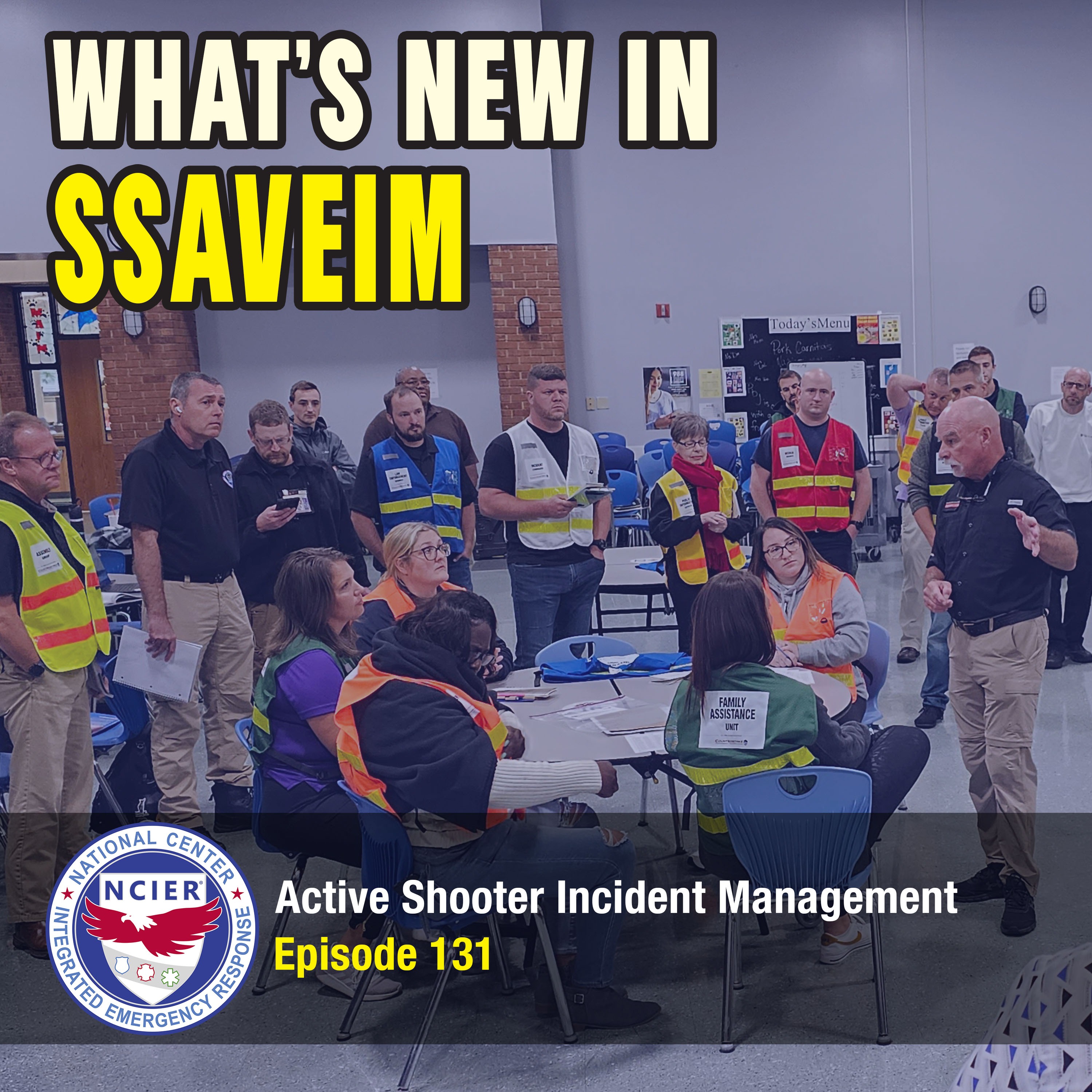
Ep 123: Who's Running Your Perimeter?
Episode 123
Published Apr 27, 2026
Duration: 18:01
Episode Summary
Where should the Perimeter Group Supervisor actually be in an active shooter response: standing a post on the perimeter, or in the command post? In this episode, Bill Godfrey is joined by Sheriff Kevin Beary and Assistant Chief Kevin Nichols to answer a listener question from a Canadian officer about positioning the Perimeter Group Supervisor, transitioning the role from a line officer to a supervisor, managing inner and outer perimeters as crowds and campuses grow, and recognizing when span of control is too large and needs to be split or supported.
Episode Notes
Where should the Perimeter Group Supervisor actually be in an active shooter response: standing a post on the perimeter, or inside the command post?
In this episode of the Active Shooter Incident Management Podcast, Bill Godfrey is joined by Sheriff Kevin Beary and Assistant Chief Kevin Nichols to answer a listener question from a Canadian officer about the Perimeter Group Supervisor’s position and responsibilities as an incident grows.
They cover:
- Why the answer depends on time into the incident and available resources
- When the Perimeter Group Supervisor may need to stand a perimeter post and run double duty early on
- Why, as staffing builds, moving that role into the command post reduces radio relays and miscommunication
- How to hand off the role from a line officer to a supervisor without disrupting inner and outer perimeters
- Managing crowds, parents, and large campuses when the outer perimeter expands
- Practical span‑of‑control cues that tell you it’s time to split inner/outer perimeter or add an aide
- Why perimeter is a critical problem‑solving role, not just where you send people who didn’t make the contact team
If you’re assigning perimeter, running the command post, or training others on ASIM, this is a useful discussion for your next training, policy review, or tabletop.
View this episode on YouTube at: https://youtu.be/Gd94JCk8rPc
Transcript
Bill Godfrey:Today we've got a listener question from an officer in Canada who was asking about the perimeter group supervisor. And his question was basically, where is the best spot for the perimeter group supervisor to set up and why? And it turns out it's a little bit complicated. Stick around. That's today's topic.
Welcome to the Active Shooter Incident Management Podcast. My name is Bill Godfrey, your podcast host. I am joined by two of my fellow instructors here at the National Center for Integrated Emergency Response. I've got retired assistant chief Kevin Nichols with us in the house. Kevin, good to have you back.
Kevin Nichols:
Glad to be here.
Bill Godfrey:
And then we've also got the inevitable sheriff, Kevin Beary, retired as well in the house. Sheriff, good to have you.
Kevin Nichols:
Absolutely good to be here Bill.
Bill Godfrey:
So we got an email from a police officer in Canada that was asking about the perimeter group supervisor, and he says, "I have a question regarding the role of perimeter group supervisor when working for a large department with significant resources. I understand that perimeter group typically switches to a separate channel for communications. In your experience, where do you generally recommend the perimeter group supervisor position themselves? Would you suggest that they're in the command post with tactical, or is it more effective for them to remain closer to the perimeter that they're actually controlling?"
So that's our topic and it turns out this one not quite so clear cut. Kevin, why don't you start us off?
Kevin Nichols:
Well, again, your favorite comment to hear from an instructor is, it depends, right? And it really does. It depends on where you're at in the response, how many resources you have on scene, and who that perimeter group supervisor is. I think initially he talks about do you want him at the command post? Do you want him on site on the perimeter or do you want him with tactical? I think we could probably take him being with tactical off the table because he's coordinating the perimeter outside of the warm zone and tacticals really focused on that inside the warm zone. We don't want him in the warm zone where Tacticals going to be to try to gum up that response.
The other two are both viable options and it really comes down to what you have in front of you, what you're looking at and what's better. Early on or with a smaller response, he might need to take a position on the perimeter, so you would assign him to the perimeter to run that group and pull double duty as both a perimeter position and a group supervisor. Later on or with a larger response, having him in the command post has a lot of benefits as well.
Kevin Beary:
I totally agree with what Kevin just said, especially when it comes to the point where if he can be at the command post, that is where he needs to be because that'll get the information that is ongoing: potential suspect suspects in the wind, there's a foot pursuit there, you know, the subjects leaving the area. You can get that information immediately out to your perimeter people so that they can deal with it.
Bill Godfrey:
Which kind of creates an interesting thing that I think there, there's two things there I think we need to dive into a little bit and talk about. So in the early response, you know, we're advocating for a perimeter group supervisor and a perimeter group to be stood up and organized pretty fast into this response. And in that early few minutes, like you said, Kevin, that perimeter group supervisor is probably gonna be doing two things. They're gonna be coordinating the perimeter and they're gonna be standing in a post, but at some point, as you get additional resources and they begin to fill that perimeter out, where is the best position for him?
Now our, our listener asked about the radio channels and said, I understand that you, that perimeter normally moves to a separate radio channel. And that's true. What that does though is it means if the perimeter group supervisor's standing a post and he's not in the command post, somebody in the command post has got two radios. They got the radio that they're listening and talking to tactical on, and they've got the radio that they're listening and communicating with perimeter on. And if you get the perimeter group supervisor to the command post, we now eliminate one of those radio relays and get face to face.
How much of a, sheriff you work in the command post doing the training a lot, how much of a big deal is that to take one of those two radios away from the law enforcement guy or gal in the command post so that they just have a person to talk to?
Kevin Beary:
Well, it, I think it totally cuts down on the miscommunication. I think that's the key. Get the vital information out to the perimeter as needed. And if you can reduce that and make it more efficient, that's one of your objectives at that command post and that perimeter group supervisor.
Kevin Nichols:
I think we all agree that face-to-face communication is the best. Human interaction. That being able to look you in the eye and understand exactly what you're trying to tell me is absolutely the best option. So if we have the manpower and we're far enough into the response to have that person in the command post, I agree a hundred percent, that's probably where he needs to be. But like we said early on, it might not even be a supervisor. It might be, I mean a ordained supervisor, somebody with stripes on their sleeves, it may be a patrol officer who got put into a supervisory position to run that group until we get enough supervisors on the scene to run it.
Bill Godfrey:
So let's talk about that a little bit. Let's assume that, okay, yeah, we've got four or five patrol officers that are the first to be detailed to get an inner perimeter started, right? And the perimeter group supervisor is one of those officers who's gonna be standing a post and it's a line officer. How do you accomplish the transition of having someone else, presumably another law enforcement supervisor take over that role from the perimeter group supervisor that's in the field, that's a just a line patrol officer and pass that off without disrupting things. What does that look like? What does that sound like?
Kevin Beary:
Well, the most important thing that we always stress in any time you take over any position in the training is you gotta get an initial briefing and that initial briefing can come from that slick sleeve deputy or regular patrol officer. He or she gives that briefing, briefs the perimeter group supervisor, and then let the perimeter group supervisor take it from there.
Bill Godfrey:
So Kevin, what does that transition look like when you've got your initial perimeter group supervisor who's standing a post and as a, as the sheriff said, is a slick sleeve and you actually have someone else, another law enforcement supervisor's gonna take over the role. What does that look like?
Kevin Nichols:
Well, like the sheriff said, the important thing is getting that brief. I need to have a really good situational awareness on where everybody is, what their assignments are and what they've accomplished up to this point. And to be able to coordinate that with your IC your, your staff in the IC, whether that's the law enforcement branch or the incident commander.
Bill Godfrey:
So if I'm hearing what you guys are saying, that the decision on whether your perimeter group supervisor is standing a post in the field or whether the standing in the command post is largely a factor of available resources and the time into the incident, timing in the incident.
Kevin Nichols:
And I think those two are coordinated. The longer the incident goes, the more resources you're gonna have. If you have a large response, right, early on, if you have, you know, 50 people show up initially on I've got enough people to staff everything I need to staff, then maybe I have somebody in the command post early on. I think the time into the incident is co-related with how many resources I'm gonna have there.
Kevin Beary:
And that also gives that, you know, perimeter group supervisor if the situation calls for more people on the perimeter, he's got a good hold on it and he can get their resources and work with the incident commander to get the, those additional perimeter resources so they can expand their operation.
Bill Godfrey:
So an example of that we saw in a couple incidents that were school incidents where there were problems at the outer perimeter crowd problems, problems with parents, problems with bystanders. In that kind of an incident, how big is your perimeter team gonna be? How many officers are gonna be assigned to perimeter duty to really secure and isolate a campus in the outer perimeter?
Kevin Beary:
I like what Kevin says, it all depends, but you know, it depends on the situation, if you've got a large group of parents and they're not unruly, you know, you might be able to hold down the numbers, but if you've got a situation where they're not cooperating, you're gonna have to get additional resources. And that means that Incident commander might have to call for mutual aid and things like that to build that outer perimeter up.
Kevin Nichols:
How large your inner perimeter is, how large your outer perimeter is, is gonna be a factor in that. How many people do I need to effectively lock that down? If I'm locking down one building, I'm gonna have maybe a smaller group. If I'm locking down an entire, like a university campus, that might be much larger. And then how much interference am I getting from the crowd that I'm trying to hold out with the outer perimeter is gonna also affect that. So again, situationally dependent.
Bill Godfrey:
All right, good stuff. Now for his follow-up question because as we traded emails back and forth, he had a couple of additional questions. He says, "Okay, if resources are scarce during the onset of the incident and you first establish an inner perimeter with the supervisor standing in one of the positions doing double duty, would that make it difficult to organize and track the outer perimeter as resources trickle in as you get 'em into staging and you get more resources that are becoming available and getting assigned to staging or sorry, assigned a perimeter. Would you recommend that the supervisor be replaced on the inner perimeter so that they can reposition to the command post or perhaps the outer perimeter?"
Kevin Nichols:
If you have the manpower available. I think the best answer is to have that person redeploy to the command post from, or either redeploy to the command post or like we talked about, have somebody come to the command post to take over for them. It's gonna be really difficult. A lot of people talk about how great multitaskers they are, and I think studies show that you can't really multitask, it just means you're doing two jobs at 50% instead of doing one job at a hundred percent. And I think the idea there is having somebody who can sit and watch that while you're standing the post is important. I think that's the better answer is to have somebody relieve you, leave you in your place, relieve you of the responsibilities of having to run the in and outer perimeter and let you continue holding that post.
Kevin Beary:
And Bill, I'd say if they are truly a supervisor on the perimeter and you get additional resources there, they know how to lead, they know how to make those decision, get 'em back to the command post and let 'em run the perimeter the way they know how to run it.
Bill Godfrey:
Yeah, I think that's a really interesting perspective. So it kind of comes down to who is your perimeter group supervisor standing the post? If it's a, you know, a line officer, you probably wanna look for a supervisor to actually plug in that role and take it over for him. But if it happened to work out that you had a sergeant or a lieutenant who just ended up being there at that time when that job was needed and he standing a post, maybe it does make sense for a line officer to replace them and for them to move themselves to the command post. The, the, the part about moving from the inner perimeter post to an outer perimeter post, I think is kind of a non-starter. I think if you're gonna make that move, make the move to the command post. Would you guys agree?
Kevin Nichols:
Absolutely.
Kevin Beary:
I do too. I agree.
Bill Godfrey:
Okay. Any other thoughts on this one? I mean, it's a, it was an interesting question and we loved getting some questions from our friends up North.
Kevin Nichols:
Especially from Canada, right? That was great. I think the thing to remember, again, you wanna kind of be cognizant of your span of control, you get that five to seven, we talked about how large the inner and outer might be. You might end up having an inner perimeter group supervisor and an outer perimeter group supervisor reporting to somebody else higher up. That's something you can work out on the today. But just being aware of that, and not overwhelming yourself.
Kevin Beary:
And I would say I agree with Kevin on that because you've got to know what's going on on the scene and you need to make those decisions. And is everything 100% written down on any checklist or anything? Bottom line is you're gonna have to make some decisions and what works best for you and your incident commander.
Bill Godfrey:
Yeah, I think you're right on the money there. The one insight I think I would add from, you know, years in the fire service, not in law enforcement, is you do have to kind of be mindful of your span of control. And I realize that the ICS doctrine says three to seven is five is optimal. That's a very abstract academic way to look at it. Your span of control and your ability to have a large or a small span of control is impacted by several things. Number one, how experienced are you in managing multiple people? And an experienced seasoned incident commander or somebody that's got experience in incident management teams is going to be capable of having and effectively managing a large, larger span of control. Somebody who's new to it, like a line officer, they may be overwhelmed past three. So the notion that they can magically go up to seven because it's written in some doctrine is foolishness.
The other thing that impacts that is the criticality and the speed with which things are changing. So even a seasoned manager, if things are moving fast and changing rapidly your ability to manage span of control decreases. And so I think you've gotta kind of take that in mind.
Kevin Nichols:
I agree with that.
Bill Godfrey:
In most instances, and tell me if I've got this wrong, in most instances perimeters, once you get 'em established are fairly stable and not terribly fast moving or changing?
Kevin Nichols:
At least that's the hope, right? You don't want your perimeter to be giving you problems. So yes, for the most part, yes.
Kevin Beary:
I would agree with that, but I would also say, with the changing times of what's going on on the street these days where they're doing takeovers and chaos, your perimeter groups may end up being much larger than you expected. And that's something that all of us in law enforcement, and all the, you know, emergency response, different sections and units, we gotta start thinking about that.
Bill Godfrey:
Yeah, I, I would agree. I think in the scenario you were giving earlier sheriff, of the school, if you're having some difficulty with parents or with bystanders and you're having to really pump up that outer perimeter team and it's problematic, you probably want to get somebody else in and start splitting up some duties and subdividing that down.
Here's my guidance to folks just generally, no matter where you land in position, when you get to the point where someone can't have a conversation with you because you're so busy listening or talking on the radio and you're on the phone and you can't write on the board, you are overloaded. It's time to subdivide. You need somebody to help you. Now that help might just be an aid that's gonna talk on the radio so that you can get the radio outta your hands and frankly that's one of the easiest ways to solve that overload problem. You're still making the decisions, you just put somebody else on the radio. And so I think that would be my guidance. Have you guys got any other insightful tips specific to perimeter or more generalized on when to recognize your span of controls outta whack or you're overloaded?
Kevin Beary:
Well, I think the one thing, everybody wants to be a contact team and if you get assigned a perimeter, that is a very important function and realize that that function may take you to additional suspects. So don't sit there and whine about it and have a pity party or anything like that. The bottom line, that's an important position.
Kevin Nichols:
I agree. There's been a lot of, there have been several instances after action reports where information from or officers on the perimeter have solved the problem. So it's not an unimportant position and it's critical to the success of the outcome.
Bill Godfrey:
I would also add that we've had two complex coordinated attacks in this country where the suspects were in the crowd around the outer perimeter at one point. And so it is a very important job.
Kevin Beary:
Absolutely.
Bill Godfrey:
All right, gentlemen, thank you very much for coming in and talking about this one. I appreciate it. Ladies and gentlemen, if you ever have any questions, we love getting those. You can send them to us at info@c3pathways.com. So info@c3pathways.com. Thank you to our producer, Karla Torres, and until next time, stay safe.