
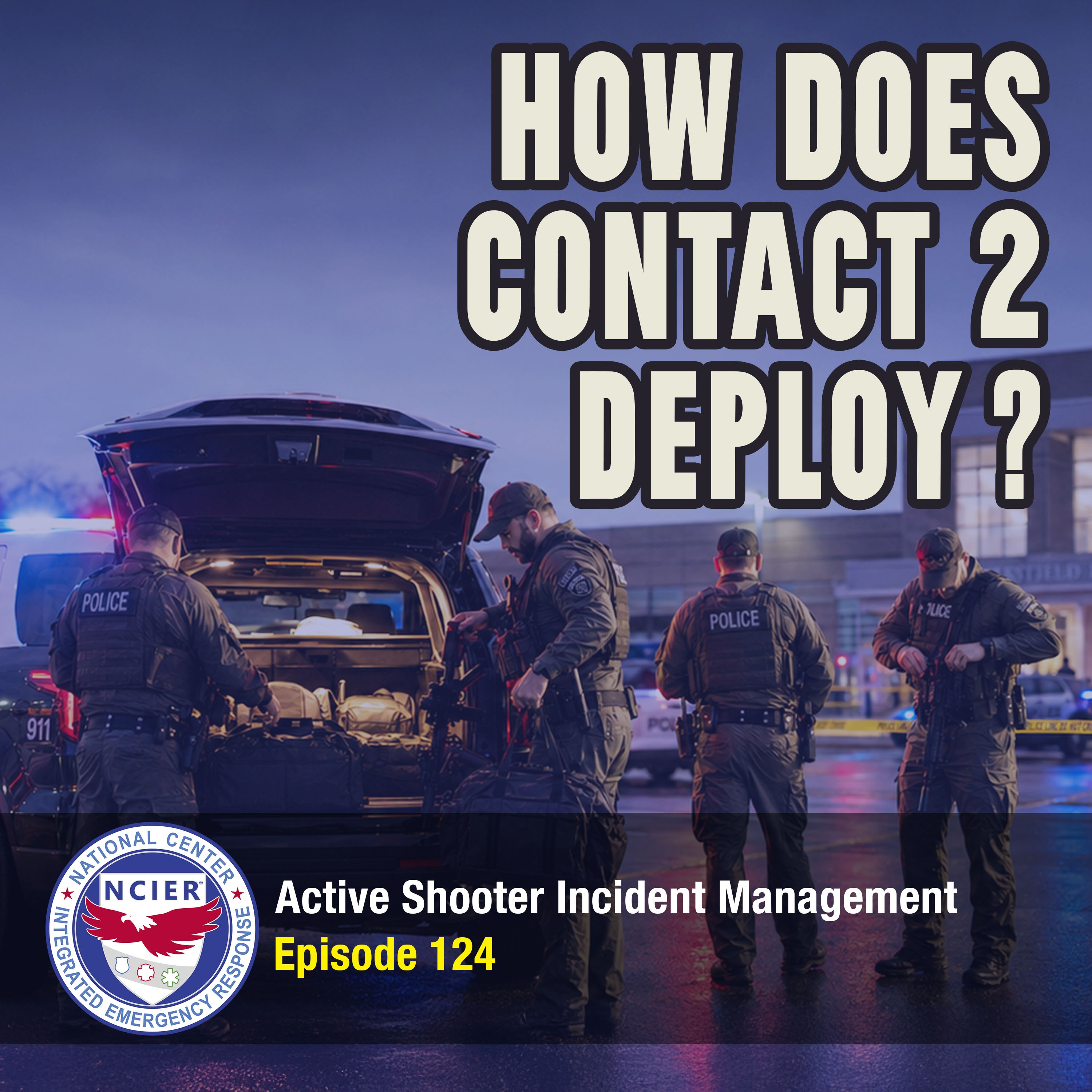
Ep 124: How Does Contact 2 Deploy?
Episode 124
Published May 4, 2026
Duration: 24:42
Episode Summary
Deploying Contact Team 2 wrong can lose precious time when lives are on the line. In this episode, we break down when to send Contact 2 forward, how to keep Tactical from getting overwhelmed, and a simple deployment checklist you can brief your officers on tomorrow so you get more cops downrange, faster and smarter.
Episode Notes
When should Contact Team 2 move downrange in an active shooter response, and how do you do it without flooding the scene or risking blue‑on‑blue?
In this episode of the Active Shooter Incident Management Podcast, Bill Godfrey is joined by instructors Kevin Nichols and Kelly Boaz to answer a listener question about Contact Team 2. Drawing on more than 2,700 active shooter exercises, they explain why the old habit of waiting on tactical to “have time” to deploy Contact Team 2 was costing minutes, and how a simple trigger and self‑forming process gets the second team there faster without creating chaos.
They cover:
- The consistent problem they saw with Contact 2 waiting in staging for tactical to call them
- The updated trigger: when the next 2–4 officers should self‑form as Contact Team 2 and move with speed and purpose
- How Contact Two should check in: tactical first, then Contact 1, then dispatch if needed
- Practical link‑up and identification habits to avoid blue‑on‑blue
- Why “flooding the scene” with freelancing officers wastes time, clogs the warm zone, and endangers RTF operations
- Using the ASIM Checklist as built‑in redundancy when tactical is overwhelmed
- A simple roll‑call briefing you can use so every officer on your squad knows their Contact 2 role cold
If you’re a patrol supervisor, trainer, or command‑staff leader responsible for active shooter readiness, this is a useful episode to turn into a short roll‑call block, in‑service talk, or tabletop drill.
View this episode on YouTube at: https://youtu.be/IL0d5mCPAyM
Download the Active Shooter Incident Management Checklist & Help Guide at: https://ncier.org/asim/checklist to give your agency a single, validated playbook for contact teams, staging, CCPs, and Unified Command.
Transcript
Bill Godfrey:We've done 2,738 active shooter exercises, and after the first 400, we realized we were deploying Contact 2 wrong. Today we're gonna give you the exact trigger of when to deploy the second contact team, and a simple checklist that you could brief your officers on tomorrow.
Welcome to the Active Shooter Incident Management Podcast. My name is Bill Godfrey, your podcast host. I am joined today by two of my other fellow instructors here at the National Center for Integrated Emergency Response. We have Kevin Nichols from our law enforcement side back in the house. Kevin, good to have you in.
Kevin Nichols:
Thanks for having us.
Bill Godfrey:
And we're also joined by Kelly Boaz, one of our longtime instructors, but first time in on the podcast, Kelly, good to have you here.
Kelly Boaz:
Thanks for having me.
Bill Godfrey:
Kelly, you're the newcomer, but you've been with us a long time, since the early days. You remember what that was like when we had the first contact team going in, we'd get Tactical stood up, and then the everybody else would wait in staging until tactical called for 'em to give 'em assignment. But what was the problem? What was it that we saw with Contact 2 that was consistent?
Kelly Boaz:
Yeah, so I mean, we learn as we move, as we go forward. Correct? So what we saw is Contact 1, team one, would get there and go right to work, but Contact 2, and we were sort of teaching that at that time, would wait in the staging area before they were called. Well, that simply doesn't work. So contact or, or the tactical supervisor or the fifth man is a deer in the headlights. He's got so much going on. So what we've learned from all this, from all these runs, is that Contact Team 2 should know that, hey, I'm gonna form up, I'm gonna let tactical know because I can't think of any situation where you're not gonna need another Contact Team 2, it could be one person, it could be a one shooter, two people injured, but you're still gonna need those fellow officers. So we learn by going by time, because on our second thing is we neutralize the threat. And time is an issue too, right? We have to get those folks down there to get help to the injured and obviously take care or neutralize the shooter. So that Contact Team 2, if they're trained and they know, Hey, I'm your Contact Team 2, we're gonna move forward and get them down and get them working.
Bill Godfrey:
Kevin, how would you put that? What was the challenge that we saw in the early days with Contact 2?
Kevin Nichols:
Tactical group supervisor comes in his position and there's a lot of information flowing through that post. It's easy for that person to get overwhelmed and that overwhelm costs time and time is one of our adversaries. So we wanted to get Contact Team 2 into the fight quicker.
Bill Godfrey:
Yeah. Bottom line, Kelly, you completely agree that was the issue that we were seeing all the time, is that it, it wasn't that the Contact 2 wasn't ready to go, is that there was a delay for tactical being ready to call them and give them an assignment?
Kelly Boaz:
Absolutely. Just like Kevin said there's so much going on in that position and they're waiting. They're, knowing cops like I do, they're chomping at the bit to get to work, but they were waiting and now we've learned from that and they're going right to work and taking care of the problem at hand.
Bill Godfrey:
So what's the way that we're teaching it today? What's the new trigger for getting Contact 2 downrange.
Kevin Nichols:
So like Kelly pointed out, we know that we're gonna need more than four cops on the scene. We know that one contact team's not gonna be enough to handle the entire scene. We know that most cases, that first contact team deals with the active threat. So we're gonna have that second contact team, once they get to staging, you get the next two to three to four officers there, they're gonna self form into a contact team. They're gonna check in with tactical and move down range immediately to start assisting Contact 1 with tactical combat casualty care, tactical emergency casualty care with setting up CCPs and AEPs and moving forward on our check marks, on our benchmarks.
Kelly Boaz:
What Kevin said is so important too. They're gonna check in, they're not gonna freelance and go out there without checking in, but they're gonna check in with tactical. He's gonna find them work or position them where he thinks they need to be. And that's gonna one, help the situation. And two, save time.
Bill Godfrey:
So in the typical active shooter event, the priority, the number one priority is to deal with the act of threat, neutralize the active threat, right? How often is that being taken care of by Contact 1 versus needing Contact 2 to deal with the threat Contact 3 and a Contact 4, et cetera, et cetera. What's the lay of the land for the, for these responses?
Kevin Nichols:
We've done a really good job training officers to deal with the active threat when it comes to active shooter response. In most cases, probably the 90th percentile, that first threat, that active threat is dealt with by one, two, or three officers. It's very infrequently it goes outside of that. So most of the time we deal with our first threat, that active shooter with the first contact team, but we have that second adversary that we have to deal with, which is the clock and that dealing with the wounded. So we're going to need additional manpower down range.
Kelly Boaz:
Absolutely. And you don't know what you don't know, correct? I mean, once that first assailant is neutralized or is down, you still haven't determined that you have a either a second threat or you know, IED or something along those lines. So that second contact team becomes incredibly important, not only to look for that, but to start getting to the injured and start setting up casualty collection points, ambulance exchange points, they could help with that, RTFs, things like that. So yes. But for the Contact Team 1, I agree with Kevin that 90% plus of the time, if trained properly, like we've been doing for years, they're gonna neutralize that threat.
Bill Godfrey:
And that's great for the cases where the threat is actually still present. How does that play out when the team arrives and the threat is not present, not active, status is unknown? How does that play out?
Kevin Nichols:
We know from the statistics, again, most cases, more than half the time, the bad guy's gone by the time or the situation is over by the time the first law enforcement officer sets foot on the scene. So we know that. However, there's still a lot of work to do. Kelly talked about it. There's still other things to do. We have to, number one, we have to start providing treatment. We have to get CCP set up, we have to get AEP set up and there is the third priority, which is to clear the scene. So we're going to need that additional manpower.
Kelly Boaz:
Absolutely. I mean it's, I cannot think of any time where you wouldn't want additional manpower and in that situation that you talked about, if I don't know where that perpetrator is yet, I'm gonna want teams, cover teams anyway while I'm getting my RTFs in there to make sure that, you know, we don't get surprised that we don't want and that we're getting our, the necessary work done and trying, trying to beat the clock, which is incredibly important.
Bill Godfrey:
Let me ask this question because there are those that advocate just having everybody flood into the scene. And so to Kelly's point, if we know that you're going to need more manpower, why not just have every arriving law enforcement officer flood into the scene?
Kevin Nichols:
I think the problem comes down to focus and purpose. Having a hundred, 200 officers show up on scene and work at their own ends without coordination, without working together towards a common goal, you're just really rolling the dice on whether they hit the objectives they need to hit. If you get them together at a rally point and give them a task and a purpose and have them start working together in a coordinated fashion, you actually save time. It becomes much more efficient and a much more effective way to deal with that second adversary.
Kelly Boaz:
You're a hundred percent right. I mean, it saves time. If officers are flooding the scene and they have no direction or specific task, then they're just clouding the scene and we're wasting time. On top of that if I'm trying to get an RTF in there, but I have all these officers and no one at the staging area to protect them if they're gonna go into, you know, the warm zone to start taking care of the injured, well how am I gonna do that? Because all my officers are freelancing and we've had cases unfortunately, but we've learned from them in this country, where it has cost time and I'll say it, it's cost lives because we're not focused like Kevin said, on the task at hand. Which we have learned through blood, if you will, because there's better ways to do it.
Bill Godfrey:
So let me ask you this, how much does it matter from a law enforcement perspective in those first few minutes? You've got your first contact team of, you know, 2, 3, 4 officers, whatever has arrived on scene and has gotten down range, they're on edge, guns up trying to figure out what's going on, deal with either an unknown threat or an active threat and then you've got another group of officers that are gonna go into that fight on edge guns up. Is that a big deal?
Kelly Boaz:
Absolutely.
Bill Godfrey:
Versus, you know, you get where I'm going.
Kelly Boaz:
I know exactly where you're going. I mean you could have a blue on blue situation, you have no control, no span of control of what's going on there and you could have a worse situation than you're already dealing with that. And we've seen that happen. So, being disciplined in your response not only saves times, but it's more efficient in your job and in your task at hand than just going in and freelancing. What you said is true. Yes. You're definitely, your adrenaline's gonna be flowing. You're gonna be, you know, this is something you're gonna remember, you know, the rest of your life when you go through something like this. But discipline is the way to go about this other than just freelancing because that's where you're gonna cost lives by doing that.
Kevin Nichols:
In individual tactics we talk about that link up, we talk about making sure if I'm that second officer coming into the scene, I wanna make sure the first officer knows I'm there before I come in. You know, doing that positive link up with the people downrange and really we're doing the same thing but on a team level. If your Contact Team 1 is downrange, having Contact Team 2 form and then contact either tactical and or Contact Team 1 to let them know, hey, we're coming in, expect to see another armed person walking into your scene. It helps alleviate that threat of fratricide or that blue on blue situation.
Bill Godfrey:
So let's kind of highlight where we are. We realized that because tactical, fifth man, needs a couple of minutes to kind of get themselves, their brain wrapped around what is happening, their situational awareness up, that there was a delay in them calling for Contact 2. So instead we're saying those next 2, 3, 4 officers that are arriving, they team up, they become Contact 2, they self form, they push forward and then they reach out to tactical to say, we're coming in, where do you need us?
Kelly Boaz:
Absolutely. I mean that is the proper way of doing that. And if they're training, if they have training to know, I should know as a patrol officer that if I'm listening on the radio and I have Contact 1 already working and looking for the threat and Kevin who is, you know, the other patrol officer, now he's the fifth man, I should know through training that okay, I'm gonna take my partner or and somebody else and team up and let tactical know that. Okay. And, and as a tactical person, I'm probably appreciative of that 'cause I, like Kevin said earlier, I got so much that I'm thinking about in the initial stages of this event that if I have a group of officers that say, here we are Contact 2, we're gonna go, where do you want us? That's going to trigger me to go, okay, yeah, I need you here and it's going to help the situation immensely.
Kevin Nichols:
It's really kind of the magic of the ASIM checklist, ASIM active shooter checklist, it's really a redundancy built into it. If you have that tactical group supervisor that gets there and is squared away and it just has everything on lock and he's not being overwhelmed. The checklist says send Contact Team 2. So he could turn and immediately launch Contact Team 2. Yeah, but for that situation where Murphy shows up or where, you know, that tactical group supervisor is overwhelmed, he's got a lot of stuff going on his band, he's overwhelmed, bandwidth is out, the second contact team, that second contact team can say, Hey, we're here send us and it checks his box, oh wait a minute, I need to send that guy down range. And it lets him do it in accomplish the task in a timely fashion.
Kelly Boaz:
Great point.
Bill Godfrey:
Okay, so we talked about Contact 2 moving forward and communicating with tactical to find out what their assignment needs to be, where they need to go. You mentioned Murphy. What happens if your Contact 2, the two of you are Contact 2, you're moving up with speed and purpose and Tacticals not answering you on the radio. What do you do then? Kelly?
Kelly Boaz:
Well, we're gonna try to communicate with Contact 1 and see where they're at and what work they're doing and whatever section that they're in, in that facility. And they're gonna let us know where they want us to go, where work needs to be done, 'cause what we're trying to do is neutralize the threat and then time becomes an issue with injured. So I don't wanna duplicate work that Contact 1 has already done. I want to continue to do good work wherever they need us and go from there.
Kevin Nichols:
And focused work, right?
Kelly Boaz:
Focused work Yeah.
Kevin Nichols:
We wanna work together to work a common purpose.
Bill Godfrey:
Yeah. So Kevin, what do you guys do, you and Kelly are Contact 2, you're moving forward. Tactical doesn't answer you on the radio, you said Okay, we'd reach, Kelly says we we'll reach out to Contact 1. What happens if Contact 1 doesn't answer you either? What then?
Kevin Nichols:
We're still moving down range still going to, because their Contact 1's going to need help. We want to let somebody know we're moving that way. So Contact 1's not answering, tacticals not answering, get with your dispatcher. You know, give them the information. 107 and 108 we formed up Contact Team 2, we're moving to link up with Contact Team 1 and once tactical or Contact 1 do get on the radio and answer up dispatch can give 'em that information and they're aware of it.
Bill Godfrey:
So what we keep talking about the link up, but what does that actually look like and sound like when Contact 2 is trying to link up with Contact 1, or any officer is trying to link up with another officer. What does that, how does that work?
Kevin Nichols:
You wanna cover it Kelly? Or you want me to jump on that?
Kelly Boaz:
Well I can either link up via radio and say, Hey I'm in section B and they're like, okay good, we haven't been there yet. Or I can link up with them physically. That's gonna cost time though. If they're already way down the corridor in a building somewhere, I'm gonna probably want to communicate with them radio if I can. Barring that we don't have that blue on blue situation, Hey, I'm in the entrance, I'm in the west entrance of this building, where do you need me? And again, Contact 1 who is eyes on is gonna be able to tell me exactly where they want me to go, what needs to be covered, which hasn't been covered yet. And keep us from doing duplicate work.
Kevin Nichols:
And in a perfect world, you want both. In a perfect world, you want that far link up on the radio or verbal or visual. And then when you get close before you step into that area where contact team, the immediate area where Contact Team 1's operating, I don't just want to appear in their operational area as an armed person without me knowing for sure that they know I'm here and that they know I'm a law enforcement officer.
Bill Godfrey:
So how do you establish that contact with 'em if it's, maybe you've called 'em on the radio but you're coming up on their position. How does that happen?
Kevin Nichols:
Shout out to 'em. Blue, blue, blue, law enforcement, Leo, Leo, Leo, flashlight strobing, some kind of something to get their attention to where they're looking at me and know, I can tell they're looking at me, I can tell they know I'm law enforcement and then I'm moving into that area.
Bill Godfrey:
Okay. Kelly, anything that you would add on to that?
Kelly Boaz:
No, he is a, Kevin's absolutely correct if I can't get him on the radio or any other way of letting him know I'm here and I'm here to help, then I'm gonna want to somehow link up with him physically so at least they see me and see my team and know that I'm not the threat and we can go from there.
Bill Godfrey:
So if you are a trainer, or you're a sergeant and you've got roll call tomorrow or this afternoon coming up, how would you brief your officers for that role of Contact 2 and what you expect them to do and everything that we've just talked about? How do you, package that up into a three minute, four minute soundbite of the instructions that you want to give your Patrol officers?
Kevin Nichols:
Contact 1 is down range, tactical has been established. Staging. If tactical has been established, then presumably staging has been established 'cause it's one of his functions, the next two to three officers should immediately form up Contact Team 2, contact either tactical or Contact 1, and move down range and follow the assignments given.
Kelly Boaz:
I'm gonna use my briefing time so my entire squad is briefed on these tactics. You, the ASIM checklist that Kevin talked about earlier is perfect. I cannot think of any time in a morning, afternoon, evening briefing when you're briefing your squad for the day where you can't take five or 10 minutes and say okay we're gonna go over this step by step. That is where the rubber meets the road in squad training because it's your squad that's gonna be responding initially to this active shooter event and everyone is gonna be on the same sheet of music. And I wouldn't do it just once. I would continue to do it day in and day out to where the newest person on that squad, that rookie is gonna be able to teach me the senior person on the squad what we're going to do.
Bill Godfrey:
I love it. Alright, so recapping this, we've got our first four officers arrive on scene, no matter what order they arrive in, they ultimately link up with each other and they are Contact 1. We had our fifth arriving officer that becomes tactical and is going to establish staging location and to start organizing this scene. Meanwhile we've got the next 2, 3, 4 officers, whatever timing and part of the reason, by the way, that we say the next 2, 3, 4 is it really kind of depends on your jurisdiction and your response times. Am I right there?
Kevin Nichols:
Yeah, that's gonna be a lot different in Mayberry USA than it is in New York City.
Bill Godfrey:
Exactly.
Kevin Nichols:
You're gonna a lot different numeric response in those two areas and a timely response in those two areas.
Bill Godfrey:
Okay. So we got Contact 1 down range, we got tactical stood up, we get the next 2, 3, 4 officers, you know, whatever the timing is that they get together quickly, they are going to become Contact 2 on their own. They're gonna self form become Contact 2. If they've hit the staging area, which is the rally point as you called it Kevin earlier, they're going to get their long guns, go bags, jump into one vehicle, move forward. They're going to make a radio call to tactical and say We're Contact 2, we are moving up, where do you need us? And if tactical doesn't respond, they're gonna instead reach out to Contact 1 and say Contact 1, we're Contact 2, we're moving up, where do you need us? And if Contact 1 doesn't answer them either, they're gonna let dispatch know we're Contact 2, we're moving up and they're going to locate and link up with Contact 1 using traditional signaling methods.
Kevin Nichols:
Absolutely. I think that ties it up with a nice bow.
Bill Godfrey:
Alright. Well this is an interesting topic. I've, over the years that we've been doing this, I find it fascinating how there are some things when we first started, there were some things that didn't work right away that were obvious and we fixed those in the early days before we even published the original checklist. But it's been interesting over time to see the little patterns of things where, wait a minute, if we make this change, we can save two, three minutes here. We can save a couple minutes here, we can save some time here. But Kelly, I love the way you said it, is that flooding into the scene, wastes time, it doesn't save time. Organizing it and putting people on their tasks saves time.
Kelly Boaz:
Absolutely it does. I've seen both and I can tell you firsthand experience that flooding the scene brings nothing but chaos to this situation and makes things worse. By being disciplined and being trained and continue to be trained and disciplined by coming to these scenes in a efficient, disciplined manner, you are saving time and in the big scope of things, you're saving lives. And that's what we do.
Bill Godfrey:
Kevin, disciplined, trained and one playbook for everybody, right? Regardless of agency jurisdiction or even discipline.
Kevin Nichols:
Yes sir. A lot of times in the first response world, we like to brag that we bring order to chaos and a lot of times what we really do is bring chaos to chaos. And the way we fix that is through that focused, coordinated response. And you get that focused coordinated response like we said, by having that rally point, by having that staging area, having a task and a purpose before we move down range.
Bill Godfrey:
One of our instructors one day was lecturing and he was talking to, and he referred to it as the polyester dog pile. And I thought, boy, that really illustrates the point when you've missed the boat and you're introducing chaos, you've just caused the polyester dog pile. And that's what we're trying to avoid.
Gentlemen, thank you very much for talking about this important topic. For those of you that are are watching, we hope you enjoyed it. If you have some questions or comments, please let us know. We love engaging with the audience. This was actually a listener question that came in for us, so you can send those over to us at info@c3pathways.com. So that's Info@c3pathways.com. Thank you to our producer Karla Torres and until next time, stay safe.