
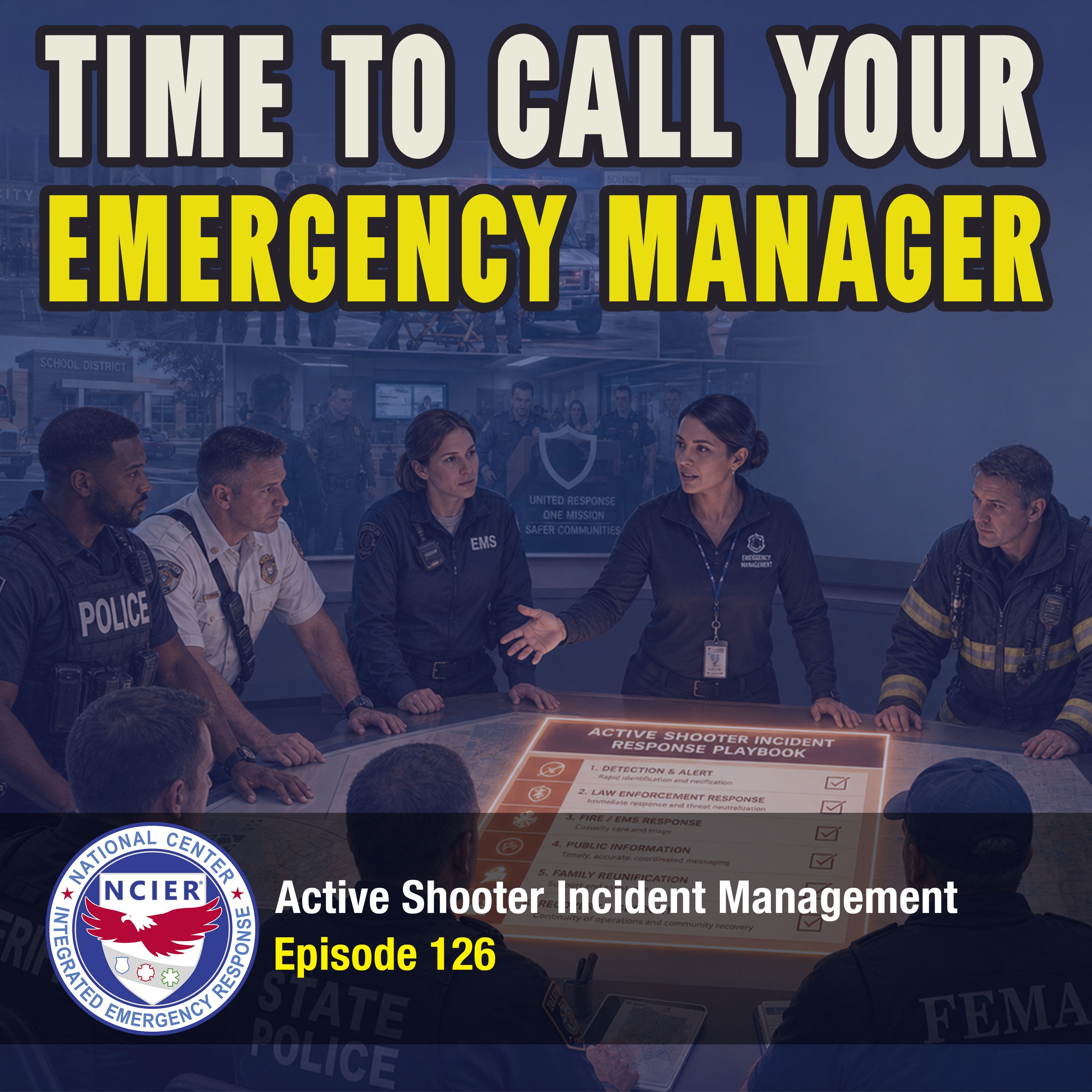
Ep 126: Time to Call Your Emergency Manager
Episode 126
Published May 18, 2026
Duration: 28:45
Episode Summary
In this episode, we look at why active shooter response changes rarely stick when a single agency tries to lead them alone, and why emergency management is the right place to own the community’s plan. Bill Godfrey, Kevin Nichols, and Kelly Boaz explain how emergency managers can bring law enforcement, fire, EMS, and dispatch into the same room, turn a checklist into a shared community approach, and move from “we think we’re ready” to trained and tested. They also share how line personnel can start the conversation with their emergency manager using a simple one page guide.
Episode Notes
Your active shooter plan needs an Emergency Manager. After 2,700 active shooter exercises across the country, we keep seeing the same pattern: one agency tries to improve its active shooter response, but without emergency management leading a shared plan, training stays siloed, and different approaches collide at the same incident.
In this episode of the Active Shooter Incident Management Podcast, Bill Godfrey talks with instructors Kevin Nichols and Kelly Boaz about why your active shooter plan needs an emergency manager out front.
They discuss:
- What happens when a single police or fire department tries to “do this on their own” without involving neighbors
- Why emergency management is the natural place to lead a community‑ or region‑wide plan across law enforcement, fire, EMS, and dispatch
- How existing EM relationships, plans, and “Rolodexes” help get chiefs and executives on the same page
- A practical path: get everyone in the same room, acknowledge the shared community problem, align expectations, then move into tabletops and exercises together
- Real examples where emergency management helped adopt a common active shooter checklist and train nearly all responders in a county or state
- How a line officer, firefighter, medic, or supervisor can approach their emergency manager and start this conversation without “jumping the chain of command”
The bottom line: hope is not a plan. In almost every real event, “everybody is coming to this thing,” so somebody has to own one coordinated plan for everybody. That somebody is your emergency manager.
Get the one‑page conversation guide mentioned in this episode to use with your emergency manager: https://ncier.org/research
View this episode on YouTube at: https://youtu.be/EnG5QLvhjn8
#ActiveShooterResponse #EmergencyManagement #PublicSafety #Podcast
Transcript
Bill Godfrey:After 2,700 active shooter exercises, we can tell you change doesn't stick until emergency management leads it. We're gonna give you today the one page ask for you to take to your emergency managers to help you implement ASIM. So right out of the gate, guys, what happens when one agency tries to implement ASIM on their own without involving their neighbors?
Kevin Nichols:
We've seen it happen multiple places, multiple times. People get it, they come to our classes, they come to our training, they get excited about the program, and they try to run it on their own. And inevitably they run into a problem with buy-in from the other agencies. I'm excited about it. I know it works. Now I have to go convince everybody else in my county, all the other responders, it's not gonna work here. We hear it frequently. This is the way we've always done it, and we can't get other people to buy in with us.
Kelly Boaz:
So the problem with doing that is you're not gonna be on your own. There's other entities coming in to help you, and you're limiting yourself from growing with those other entities as well and learning from them and moving to a successful conclusion.
Bill Godfrey:
It's interesting, Kelly, the entire idea of the active shooter incident management checklist is this one playbook, one plan for everybody. Not just law enforcement, but law enforcement, fire, EMS, dispatch, the entire response ecosystem. And how does that work if we don't have our mutual aid partners also involved?
Kevin Nichols:
It doesn't, I think is the answer to your question. It doesn't work. And the idea of being an integrated response, of working together, not just between different disciplines, but also between different jurisdictions and agencies, because we all know, we ask the question frequently, who's coming to this thing? Well, everybody's coming to this thing. And to have everybody on the same playbook is the only recipe for success.
Kelly Boaz:
You are absolutely so right, Kevin, in that statement. If I have a group of officers that are on one playbook and a group that are on another playbook that is gonna cause a major issue, it's gonna cost time. Maybe a blue on blue situation as well. And, but if I have everyone knowing their responsibility on the same playbook, that is gonna be a smooth transition and a successful outcome.
Bill Godfrey:
So we talk about emergency management being the one that needs to solve this. Why? Why is emergency management, and maybe we take the question a different, a little bit different way. What can you predict of failures if you don't involve your emergency manager when you're trying to implement ASIM in your region?
Kelly Boaz:
I'll give you a bomb analogy that we use at the school, is the emergency manager is the gatekeeper. Everyone is going through them for training, for knowledge, for implementation. And if you do that, then the path is very successful. If you don't have that emergency manager and everyone's going through different paths, then your outcome is probably not gonna be as successful as if everyone was on the same sheet of music.
Kevin Nichols:
An emergency manager is uniquely positioned to work with. They already do it in their everyday life. They're uniquely positioned to work with the different disciplines and the different response agencies from the jurisdiction from the county, say to where you have multiple municipal jurisdictions and county jurisdictions. They work with those agencies all the time anyway. So having them house this program just makes sense.
Bill Godfrey:
So what are the things that will go wrong? Let's say the local police chief decides, you know, I want to try to do this and doesn't involve emergency management or the emergency manager. What are the roadblocks and the challenges that they're gonna run into? What are the failures that that police chief is gonna encounter along the way?
Kevin Nichols:
When we're talking most of our training about PPE personalities, politics, and egos, right? So the idea being that that police chief comes in and has a good a, you know, a right-minded effective response to this program, but without getting the buy-in from the fire department, from the EMS response, from the dispatch center, which may be a separate agency from other agencies in his department. If he's not able to get that buy-in, if they train in silos and don't train together, if they don't coordinate their response and their training, that's a failure on game day.
Bill Godfrey:
Interesting. So really, when you think about trying to implement active shooter incident management as the one common playbook, and you step back from it a little bit, you say, okay, who is the group or entity that is responsible for a countywide plan or a regional plan, a disaster plan? Who's the group that over, you know, kind of has this umbrella? Not in terms of reporting hierarchy, but just in coordination. Who's the group that coordinates all of the responders?
Kelly Boaz:
Yeah, it's your emergency managers that do that. And they should be excited about doing that as well. I mean, you're getting fire on the same page as EMS if it's different in that jurisdiction on the same page as law enforcement. And that person is basically the coach, if you will. I have a team, I have a good team of offense and defense, but I've gotta be on the same sheet of music to win that game. The same thing with your emergency manager. Their task is to get everyone on the same sheet of music. So when game day does come, it's a successful outcome.
Kevin Nichols:
As you pointed out, the emergency manager already does that with your standard EAPs, with your standard, you know, emergency action, emergency response plans. They already coordinate between the difference, the differing disciplines inside that jurisdiction. This is just an extension of that.
Bill Godfrey:
And they should already have the relationships.
Kevin Nichols:
You would hope so. That's one of the strongest things most in most emergency management functions is that relationship. Back when I came through, we were talking about the Rolodex, and most people nowadays don't know what a Rolodex is, but you know, the idea of having the contacts, having the information, having that a hundred dollar or a hundred million dollar handshake beforehand, knowing who to call when, the EM has all of that, if they're doing their job effectively, and most of 'em do a really good job of that. So knowing who to call, who to get in touch with, who can I get in touch with to get this agency on board with this plan? That's where you going wanna go with 'em.
Kelly Boaz:
And not only that, but, and that's a very good point, Kevin, but also introducing them to each other. That should be part of their job as well. Not only that I should know who to contact and go meet, but I should set up meetings with all the leaders and so they're all in the same room and starting those conversations that need to be had.
Bill Godfrey:
So if emergency management is the right place, if you will, to house the implementation of active shooter incident management to get a region ready or, and I use the term region, you know, maybe it's a group of cities, it's a county, it's multiple counties. It kind of just depends on the locale, but if emergency management is the right place to get that done, what does that start to look like? How do you get started? What are the steps that you'd need to go through? What do we need to ask the emergency managers to do?
Kevin Nichols:
Well, I think it starts with having a plan. So we talk about being on the same page with the plan. The idea is to have that plan. And we've put together, NCIER has put together a really effective proven, you know, validated plan to make this work. So bringing that plan together and then bringing the people who are gonna be working that plan, bring in your police departments, your sheriff's departments, bring in your EMS agencies and your fire departments, get them into the same room and let them know this is the plan we're looking at, so that they can start working that plan and understand their role and not silo up. Right? The idea of not training in silos is very important.
Kelly Boaz:
And talk to them, talk to the leaders. What are your concerns? More times than not, the agency leaders have thought about things like this and like, okay, how am I gonna implement this contact team with the fire department might not know about RTFs or the fire department? What are we gonna do? Where do you want us in this type of situation? And get that information. And like Kevin says, come up with a plan, get 'em all on the same sheet of music, and then slowly start implementing that and talks and then maybe tabletops and then maybe scenario exercises and continue to grow through this process.
Bill Godfrey:
Yeah, I think it starts with just getting everybody in the same room and starting the conversation. There are hardly, I mean, it's so commonplace, it's hard to imagine it not occurring, but almost any place that we go, you find there's an issue between this agency and that agency. You know, they've got these relationship challenges or they don't like each other, or you know, one's more advanced, whatever. It turns out to be important to those people that are involved. But in the big picture, they're kind of missing the big picture of the thing. So I think it starts with trying to get everybody in the same room to talk about it, Kelly, like you said, and then I think to some degree get everybody to acknowledge that this is a community problem. That it's not just a problem for one police department or one sheriff's office or one EMS agency that only has three or four ambulances on duty, and how are we gonna solve, this is a community problem and we need to get everybody on the same page. That's easier said than done, isn't it?
Kelly Boaz:
It is, unfortunately, but through conversations, through meeting, through even having disagreements and working them out becomes important. I think it's incredibly important to remember we all work for the same folks, the community people that live in that community, we all swore raised our right hand and swore an oath. Whether I'm a firefighter, an EMSA police officer, those are my priority. Those who I work for, they depend and probably would demand us to be on the same sheet of music to solve, you know, a crisis like an active shooter thing. So absolutely, and starting to talk it out, I think is the key initial step in ironing out any maybe philosophy differences you may have.
Kevin Nichols:
I think having that initial meeting, like we talked about is incredibly important. I think getting everybody in the same room, number one, you can hear their, you can hear their objections, you can hear their concerns, but it lets everybody know moving forward, we're on the same page. We have a plan, you have a role in that plan. This is what our expectations are of you. This is what you can expect from us. It also doesn't hurt. A lot of times your emergency manager has the ear of the chief administrator of that area, right? The county administrator, the city administrator, they have the ear of them because they work with that chief administrator so closely and having the boss say, this is the way it's gonna be, can kind of help you with that.
Bill Godfrey:
Yeah, it's, look, we've all been there. It's nice when we as responders can come to our own agreement and not be told from the top down how we're going to do it. So that generally works out better for us to kind of come along with a plan and come along aside each other than being told to do it. But the truth of the matter is, is that there are, in most states, there are legal mechanisms for, for example, a county to say, this is our emergency management plan. It gets formally adopted by the elected officials and it has the effect of law, almost like passing a statute to say, this is how it has to get done. And so it's, it's better for us as responders, I think, to kind of come together and acknowledge that in 99.9% plus of communities in the United States, you are not going to be handling this on your own. And if your, if your other disciplines are gonna be present and they are, and your neighbors are gonna be present and they are, then we need to have everybody on the same page.
So it starts with emergency management, getting everybody in the room and kind of acknowledging it. Now how big a deal is it for the executives? So the police chief, the fire chief, not necessarily the deputies or the assistant, but the actual organizational leaders to be in the room and to knowledge with the other ones that even if they think they're ready, they don't know that they're ready and it keeps 'em up at night. How important is that for the emergency manager to be able to draw out whether it's through one meeting or multiple meetings?
Kevin Nichols:
I think nobody wants to be that guy that has a unsuccessful response to these type of incidents. Nobody wants to be on the news. Nobody wants to be the person losing their job or possibly being prosecuted. And I think most of us would like to believe, yeah, I've got a good plan, I've got good people working for me, we know what to do. But like you just pointed out, there's a difference between I think and I know that I'm ready. And having your EM lead that case to where we get everybody in the jurisdiction, everybody in that region on the same page in a trained and not only trained, but tested manner. So where we can run simulations, we can run exercises and test their response so that they know that they've got what they need in place is incredibly important. And it lives with the EM.
Kelly Boaz:
Yeah. In a crisis situation, you don't rise to the level of your expectations, you fall to the level of your training. And that all starts with that police chief, fire chief being up at night going, how can I make it better? How can I prepare my folks for when it's game day we are ready. And I don't know if you ever get over that, you should always look what's the next step that we can take and stay hungry in that aspect. And to me that is, that is a level of success.
Kevin Nichols:
And as a leader, if you do get over that, if you get to that point where you're not thinking, how do I make my people better and how do I plan for it, then maybe it's time to look at retire the retirement side. Right?
Kelly Boaz:
Time to retire.
Bill Godfrey:
Fair enough. Let's shift gears and talk about a couple of examples where we've seen this work very, very successfully with emergency management leading that, steps they went through. We've talked about the importance of that kind of the first foundational meeting and the one that I'm thinking of, the community, there was a local police department and fire department that kind of got, they were a city police department, fire department. They got on the same page. And when I say they got on the same page, it was actually about a half a dozen people on each side that was compassionate about this. And they wanted to try to implement it countywide, but they knew that they were gonna have some challenges. They had I think about two dozen other municipalities plus the county agencies, and they went to their emergency manager who did that organizational meeting and started the conversations. And it took a couple of months, but it really played out very well with, I think once they got over the hump of everybody acknowledging that this was a concern and that they did have a wild range of policies and procedures in place on active shooter response that ranged from a 30, 40 page manifest destiny on how we're gonna respond to an active shooter to agencies that had nothing written at all.
So once they got over that hump and got everybody to acknowledge the problem, what happens then? What are the challenges that are gonna come up? So, everybody's acknowledged the problem, we're ready to take action on it. How does that play out, Kevin? You know, the one I'm, I've got in my mind.
Kevin Nichols:
I believe so.
Bill Godfrey:
Talk a little bit about the practical steps that they took to begin to implement it.
Kevin Nichols:
Well, once you realize we have the problem, so we have this problem where there are multiple levels of training, multiple different types of policy its having those conversations to decide this is what our policy's going to be. And before I even think you get to that point, you have to see what's out there and then getting your people trained and running the exercise, getting the training in, providing the training for a large portion of your response base to test to see will this work here? And if it does work here, how do we codify it to make sure that everybody has one plan? And it's the same plan across the entire region.
Kelly Boaz:
Yeah. It goes to the leaders to understand exactly what Kevin just said is what is the best plan possible for a successful outcome. I think about the ASIM checklist, it's not that in depth, there's not 30 pages to it. It's pretty simplistic if you think about it. And it's a guide that everyone can and should use for a successful outcome.
Bill Godfrey:
Yeah, and I think, so they started off with expanding the training. So this, the city police department and fire department had already had some training and then they scheduled some other training opportunities using some grants, some DHS grants and some local state grants and brought the other agencies in. And they got fairly broad buy-in very quickly on that. The emergency manager then worked with those communities and their grant funding sources and secured some grant to pay for ASIM basic train the trainer. And over the course of 12 months, they not only implemented a countywide plan that formally adopted the active shooter incident management checklist process, but incorporated that as a plan and got a hundred percent of their police, fire, and EMS, I say a hundred percent, 99 plus percent. I mean you're only a hundred percent the day you finish the training and then somebody retires, promotes, or you hire a new person, right? But they got every responder, police, fire, and EMS through ASIM Basic. And they did that in a year. I thought that was a pretty amazing feat.
Kevin Nichols:
It really is. And it only worked because the emergency management agency was the one leading that. You can't have one, I can't be the city police, even if I were the largest city in the county, I can't go to their other agencies in the county and say, thou shalt take this training. It's not gonna go over well. But your emergency managers, the people have those conversations. People have those relationships that can bring them all together to say, yes, this is where we would like to go get that buy-in and then get that a hundred percent, or like you said, 99% training level to where everybody's on that same plan.
Kelly Boaz:
That emergency manager in the situation you're talking about is an unsung hero to bring all these entities together for successful training and a successful outcome. That is the definition to me anyway, of what an emergency manager is responsible for.
Bill Godfrey:
I completely agree. And we've seen this play out at the state level too. There's one of the states that adopted ASIM statewide, did it through the emergency management program and the emergency management side of the state organization and included funding, grant funding for the training to be able to get done through their programs.
So let's move to the next step. You're listening to this podcast. You're a cop, you're firefighter, EMT paramedic, maybe an EM, but you care about this. You're passionate, you see the problem, you know the problem. Maybe you've already had some ASIM training, you're trying to figure out how to get adopted in community. What's the conversation that you need to have with your emergency manager?
Kevin Nichols:
Go to your emergency manager, present them with the stuff you got in class. This is what we think is the right way. We think this is the answer because we've seen it work. It was proven in the 10 to 11 scenarios you ran in class. Okay, excellent. Then have them start putting together that initial meeting. We have to get people together, we have to, these are the people we want to include as big of a net as you can cast. Let's get all the response agencies, all the law enforcement, all the fire, all the ems, all the multi-level state and you know, local city, county and possibly state government into the room to make sure that they're all on board.
Kelly Boaz:
Yeah, I completely agree with that. If I can go to this training and I see that I, that this is successful, which it is and we need it, I'm gonna definitely go to my EM and say, okay, we need to start getting conversations like we've talked about at length now, get everyone in the same room, learn from each other and then go, you know, go the entire way to training.
Bill Godfrey:
Yeah, I think it's a really interesting perspective in police and fire we're fairly rank structure oriented, very chain of command oriented. And if you are a line person or even a first level supervisor, it's not like you could jump over three or four levels of supervision to go talk to the police chief or the fire chief. That is, shall we say, frowned upon. And typically has a suboptimal outcome. But the emergency manager almost universally, not everywhere, but big, big majority of emergency managers kind of sit outside of that typical chain of command. And it's not really inappropriate for me as a line level person or a line level supervisor to call the emergency manager and say, Hey, can I get together with you and kind of talk about this thing that's on my mind.
What I would say the pitch would be to the emergency manager is, look, this is a really big deal we have, or have not had an active shooter event in our community, but we're as much at risk as every other community out there. And while I think City X police department, you know, my department or my fire department has a good plan, it's not a shared plan. And shared plans are your domain, Mr. or Mrs. emergency manager. And I think we are not going to be able to solve this active shooter response problem until you solve it. Mr. or Mrs. emergency manager, that is, this is the sweet spot of what emergency management exists to do, is to help agencies coordinate across the agencies, coordinate across jurisdictions, coordinate across disciplines, and that's exactly what's needed here. And we need a countywide plan and I need your help.
Kevin Nichols:
And it's what the EM does in their everyday life. They do that in every and multiple different facets of response. They do that with flood response, they do that with tornado response. We put together a high water rescue team at my old agency and our EM ran that program bringing in people from public works, from law enforcement, from fire, and getting them all on the same page. And it really is very effective when the EM runs it.
Kelly Boaz:
The EM is probably used to dealing with mid to upper level management folks, I would think as an EM, if I had a line supervisor come to me or somebody, you know, a patrol officer or whatever and give them ideas, they would chomp at the bit for that. They want to talk to you, they want to bring what's needed to your community. And when you come to them and know that you're looking for help from them, they're probably gonna be very receptive to that.
Bill Godfrey:
That is the nature of the emergency management business is they are there to help public safety solve problems when there are public safety problems. And this is a public safety problem that needs to be solved before the incident occurs and emergency managers are the only ones that can solve it.
Kelly Boaz:
Yes sir.
Kevin Nichols:
If you have that possibility, you know, like you just said, we're at much of a risk of this happening in our area as anybody else in the nation. If you're aware of that risk and you fail to plan for it, that's on you. And the way you plan for it is by getting that jurisdictional, because look man, I can plan for my agency and have the best plan in the world, but if everybody else we've talked about, everybody else is gonna be showing up to this thing if everybody else that shows up to this thing's not on the same page, it's failure.
Kelly Boaz:
Unless you're New York City or something along those lines, name me a jurisdiction where you're not going to have another entity come in and help with a crisis like a active shooter situation. So it's incumbent upon the EM to get everyone on the same sheet of music so you're on the same team on game day.
Bill Godfrey:
Absolutely agreed. And I think EMs are really the only ones that can actually solve this problem in a community because the other ways are hard, long and arduous. But the emergency manager can help pull the agencies together, help pull the plan together, build a coalition of support, not just from public safety, but also from the elected and appointed officials at all of these different jurisdictions. They can be the keeper and the maintainer of the plan and they can help secure the grant funding to pay the cost of getting the training done and maintaining it. And I think that's the big thing. The one thing I would say is when you go to talk to your emergency manager, don't drop a 60 page binder on 'em.
Kevin Nichols:
Oh no.
Bill Godfrey:
Just have a conversation.
Kevin Nichols:
Yeah, just have a conversation. And you know, you talked about the funding, you talked about the planning, you talked about the relationships. And that is really in a nutshell what emergency management does, the funding, the planning and the relationships.
Kelly Boaz:
Absolutely.
Bill Godfrey:
Gentlemen, thank you very much for coming together to talk about this topic. For those of you that are interested in this, we're gonna have a link in the show notes. That'll be a link to a one page document that's just got a little short bullet point list for you to discuss with your emergency manager.
If you have any questions or comments, please send them in to us. You can send those comments to us at info@c3pathways.com. That's info@c3pathways.com. Thank you to our producer, Karla Torres, and until next time, stay safe.