National Center for Integrated Emergency Response®
State of BTAM
Behavioral Threat Assessment & Management in K–12 Schools
2025 Survey • 1,746 School Leaders • National Sample • Source: RAND Corp / HSOAC
01. Core Themes
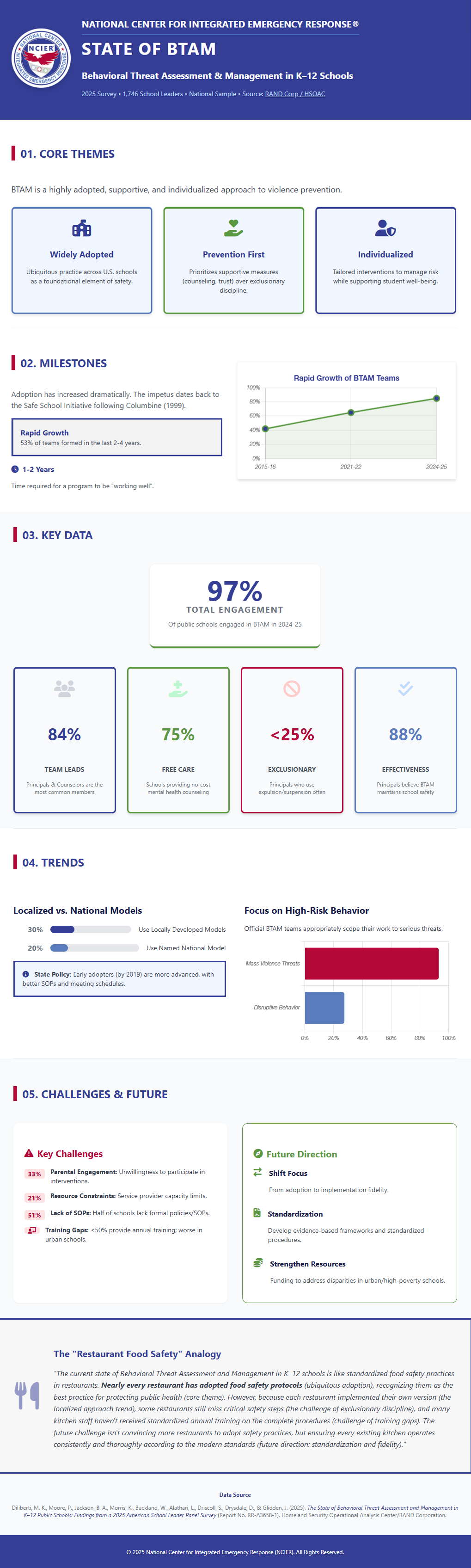
BTAM is a highly adopted, supportive, and individualized approach to violence prevention.
Widely Adopted
Ubiquitous practice across U.S. schools as a foundational element of safety.
Prevention First
Prioritizes supportive measures (counseling, trust) over exclusionary discipline.
Individualized
Tailored interventions to manage risk while supporting student well-being.
02. Milestones
Adoption has increased dramatically. The impetus dates back to the Safe School Initiative following Columbine (1999).
Time required for a program to be "working well".
03. Key Data
Of public schools engaged in BTAM in 2024-25
84%
Team Leads
Principals & Counselors are the most common members
75%
Free Care
Schools providing no-cost mental health counseling
<25%
Exclusionary
Principals who use expulsion/suspension often
88%
Effectiveness
Principals believe BTAM maintains school safety
04. Trends
Localized vs. National Models
Focus on High-Risk Behavior
Official BTAM teams appropriately scope their work to serious threats.
05. Challenges & Future
Key Challenges
- 33% Parental Engagement: Unwillingness to participate in interventions.
- 21% Resource Constraints: Service provider capacity limits.
- 51% Lack of SOPs: Half of schools lack formal policies/SOPs.
- Training Gaps: <50% provide annual training; worse in urban schools.
Future Direction
From adoption to implementation fidelity.
Develop evidence-based frameworks and standardized procedures.
Funding to address disparities in urban/high-poverty schools.
Data Source
Diliberti, M. K., Moore, P., Jackson, B. A., Morris, K., Buckland, W., Alathari, L., Driscoll, S., Drysdale, D., & Glidden, J. (2025). The State of Behavioral Threat Assessment and Management in K–12 Public Schools: Findings from a 2025 American School Leader Panel Survey (Report No. RR-A3658-1). Homeland Security Operational Analysis Center/RAND Corporation.
© 2025 National Center for Integrated Emergency Response (NCIER). All Rights Reserved.