Which part(s) of the course was MOST valuable to you. Please explain why.
Student did not leave a written comment.
Most school incidents break down because schools and responders train separately. SSAVEIM™ Train-the-Trainer is a two‑day course that certifies your own local trainers to deliver a unified violent event incident and reunification playbook for school staff, law enforcement, fire/EMS, and emergency management.
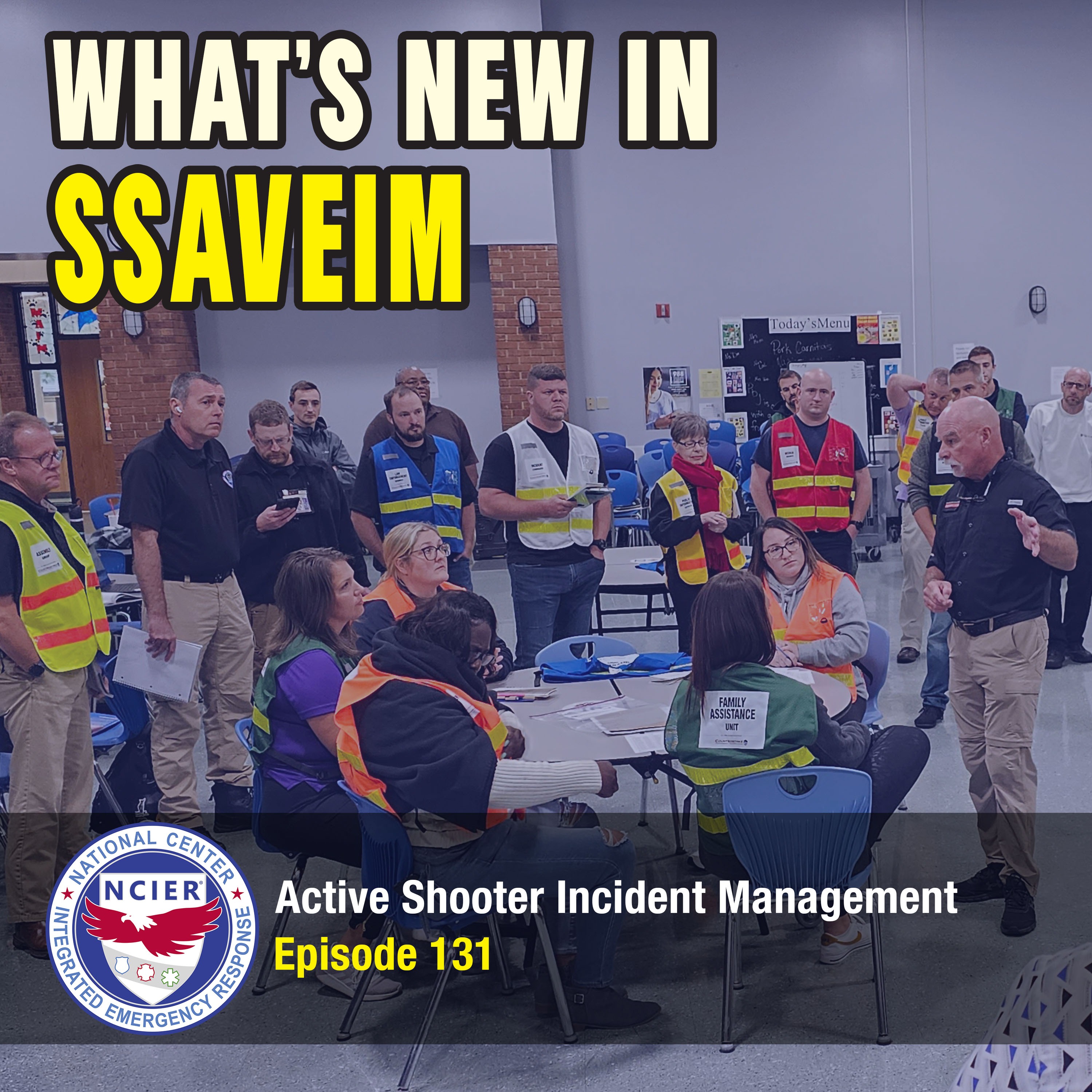
The goal is simple — decrease the time to neutralize the threat, get injured to a hospital, and reunite students with their families. SSAVEIM brings school leaders, law enforcement, fire/EMS, and emergency management into the same room, on the same plan.
Train school staff, law enforcement, fire/EMS, and emergency management together on a single, integrated school incident playbook, including reunification.
Your trainers keep the materials, checklists, reunification kit, and LMS access so you can refresh training on your schedule.
Shared training, clear roles, and course certificates help schools and responders show they’ve trained together on the same plan.
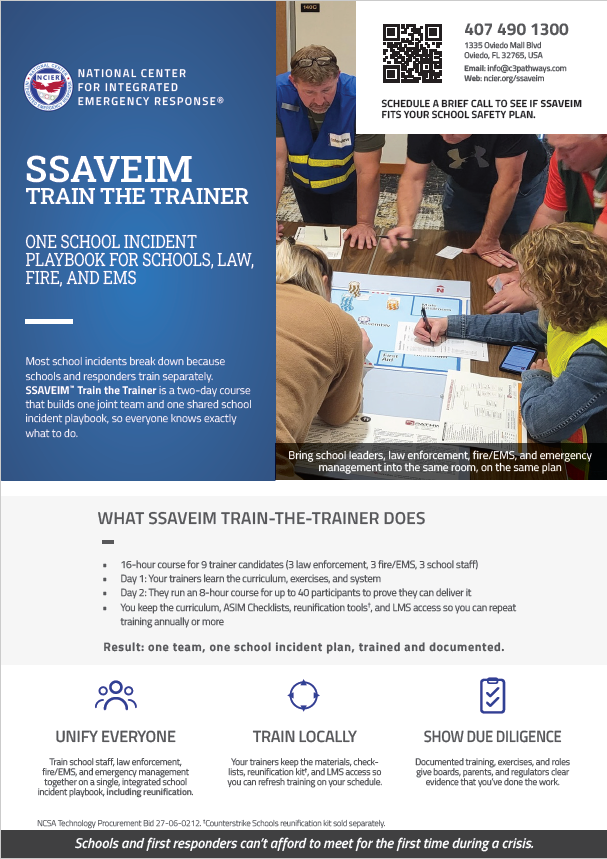
A 16-hour course for 9 trainer candidates — 3 law enforcement, 3 fire/EMS, 3 school staff. Over two days, your trainers learn the curriculum, prove they can deliver it, and leave ready to repeat training annually.
Your trainers learn the curriculum, exercises, and system.
They run an 8-hour course for up to 40 participants to prove they can deliver it.
This course provides you with the experience and confidence to respond to a violent event, regardless of your daily responsibilities. Participants are trained to secure the students, identify the threat, provide medical intervention, and reunify students with their loved ones.
School personnel work alongside law enforcement, fire/EMS, dispatch, PIO, and emergency management — so your team meets and trains together before a crisis, not during one.
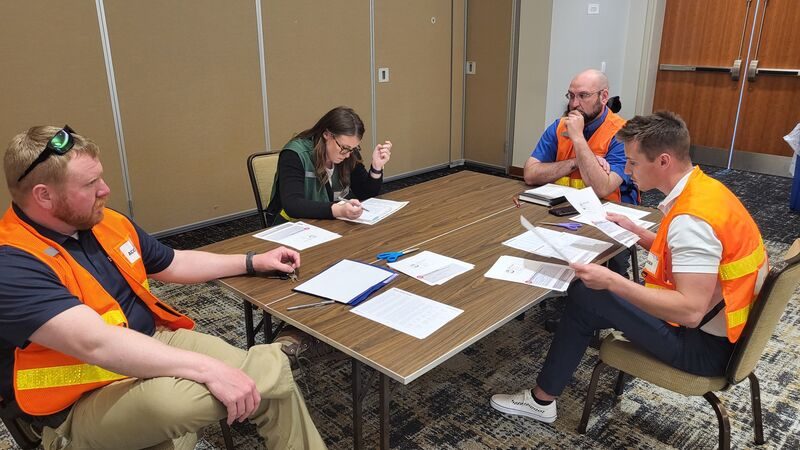
Full-scale exercises utilize Counterstrike™, a tangible tabletop tool which provides a bird’s eye view to the incident, generating a greater understanding of the process.
Participants rotate through different roles and assignments so everyone understands the full range of violent events and responses.
Instructors utilize a no-fault, no-embarrassment coaching style, providing hands-on experience for entry level and executives alike.
Your trainers keep everything they need to deliver SSAVEIM locally and repeat training on your schedule — with no per-delivery fee from NCIER.
Bring school leaders, law enforcement, fire/EMS, and emergency management into the same room, on the same plan.
Hosts provide the venue, AV support, and participants. NCIER provides the SSAVEIM curriculum, Counterstrike™ Reunification tools, and instructor team.
Here’s what happens over the next 1 business day.
Keep an eye out for a call from (407) 490-1300. If you don’t hear from us within 1 business day, call us at (407) 490-1300.
Prefer to talk now? Call (407) 490-1300.
ASIM QuickStart gives every responder a shared incident management baseline. SSAVEIM Train-the-Trainer builds one joint team and one shared incident playbook, so everyone knows exactly what to do.
15–20 minutes, no obligation. We’ll help you figure out if hosting SSAVEIM Train-the-Trainer makes sense for your schools.
Schedule a Brief CallWhich part(s) of the course was MOST valuable to you. Please explain why.
Student did not leave a written comment.
Which part(s) of the course was LEAST valuable to you? Please explain why.
Student did not leave a written comment.
Please provide any other comments or suggestions you have for improving this course.
Student did not leave a written comment.
What other training is most important to you now that you have completed this course?
Student did not leave a written comment.
Which part(s) of the course was MOST valuable to you. Please explain why.
I found the course to be very informative and gave me a a significant amount of information about the incident management from all sides and where I would fall in the process.
Which part(s) of the course was LEAST valuable to you? Please explain why.
Student did not leave a written comment.
Please provide any other comments or suggestions you have for improving this course.
Student did not leave a written comment.
What other training is most important to you now that you have completed this course?
Student did not leave a written comment.
Which part(s) of the course was MOST valuable to you. Please explain why.
Discussing and practicing the roles related to reunification. Being in the school setting, this is an area we need to improve.
Which part(s) of the course was LEAST valuable to you? Please explain why.
Student did not leave a written comment.
Please provide any other comments or suggestions you have for improving this course.
Student did not leave a written comment.
What other training is most important to you now that you have completed this course?
Student did not leave a written comment.
Which part(s) of the course was MOST valuable to you. Please explain why.
Hearing how non-school authorities would respond, what they will focus on.
Which part(s) of the course was LEAST valuable to you? Please explain why.
The second simulation was hard to follow, I thought the first one that was slow and deliberate was the most helpful and informative.
Please provide any other comments or suggestions you have for improving this course.
Providing time for local groups to collaborate at the end would be nice.
What other training is most important to you now that you have completed this course?
More training on post-event activities would help.
Which part(s) of the course was MOST valuable to you. Please explain why.
Practical exercise.
Which part(s) of the course was LEAST valuable to you? Please explain why.
All valuable.
Please provide any other comments or suggestions you have for improving this course.
None.
What other training is most important to you now that you have completed this course?
Large incident management.
Which part(s) of the course was MOST valuable to you. Please explain why.
Hands on modules.
Which part(s) of the course was LEAST valuable to you? Please explain why.
N/A.
Please provide any other comments or suggestions you have for improving this course.
Quick cheat sheet of acronyms for school people for LE language.
What other training is most important to you now that you have completed this course?
Distirct training and run throughs.
Which part(s) of the course was MOST valuable to you. Please explain why.
Thanks.
Which part(s) of the course was LEAST valuable to you? Please explain why.
Thanks.
Please provide any other comments or suggestions you have for improving this course.
Thanks.
What other training is most important to you now that you have completed this course?
Thanks.
Which part(s) of the course was MOST valuable to you. Please explain why.
Student did not leave a written comment.
Which part(s) of the course was LEAST valuable to you? Please explain why.
Student did not leave a written comment.
Please provide any other comments or suggestions you have for improving this course.
Student did not leave a written comment.
What other training is most important to you now that you have completed this course?
Student did not leave a written comment.
Which part(s) of the course was MOST valuable to you. Please explain why.
Reunification.
Which part(s) of the course was LEAST valuable to you? Please explain why.
A good class.
Please provide any other comments or suggestions you have for improving this course.
Na.
What other training is most important to you now that you have completed this course?
Na.
Which part(s) of the course was MOST valuable to you. Please explain why.
The reunification.
Which part(s) of the course was LEAST valuable to you? Please explain why.
The scenarios were a bit hectic due to size of class and limited availability to communicate via yelling across the room.
Please provide any other comments or suggestions you have for improving this course.
Common ICS terminology for the naming conventions (tactical, Triage and transport) could better be defined under an operations chief and managed by specific managers. Also the idea of officers designating their own call sign, while being command could create confusion to other responders if a proper command transfer process doesn’t happen. Creating freelancing and training scars.
What other training is most important to you now that you have completed this course?
Student did not leave a written comment.
*Evaluations are collected from verified course participants and published without editing. Ratings and comments reflect each participant’s individual experience.