Which part(s) of the course was MOST valuable to you. Please explain why.
Table top excersises.
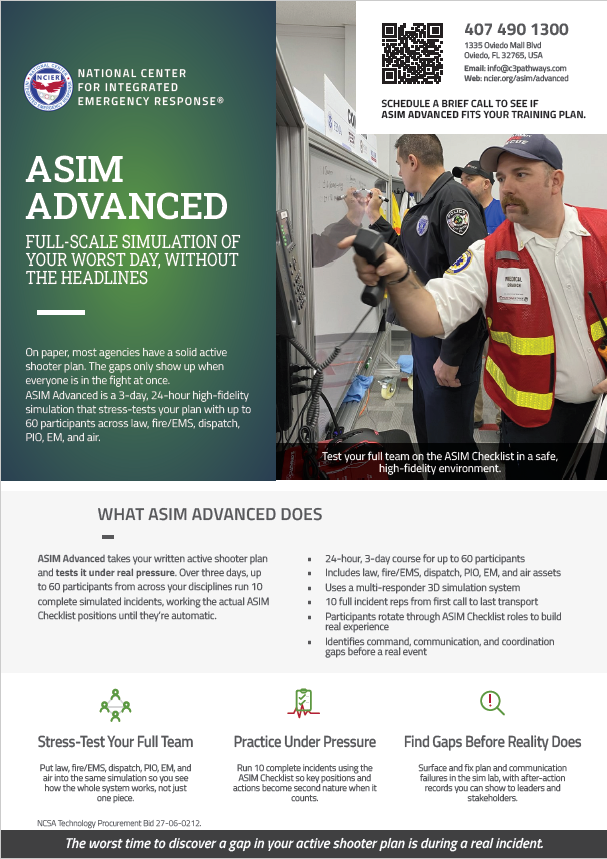
Tabletop exercises and written plans are essential starting points, but they can’t show how your system performs when the clock is ticking. ASIM Advanced is a 3‑day, 24‑hour, high‑fidelity simulation course for up to 60 responders that runs 10 complete active shooter and complex coordinated attack incidents from first call to last transport. Your full team sees how the ASIM Checklist performs under pressure across law, fire, EMS, dispatch, PIO, emergency management, and air assets.
Most agencies have plans, policies, and tabletop exercises, but very few have seen their full team manage multiple complex attacks at operational tempo. ASIM Advanced brings law enforcement, fire, EMS, dispatch, PIO, emergency management into the same room and the same simulated incidents. You get real repetitions, real decisions, and real data on how your system performs when seconds matter.
Move beyond discussion‑based exercises into 3D simulation where radio traffic, injects, and timelines force real‑time command and control decisions.
Run 10 complete incidents using the ASIM Checklist so every function practices the same priorities, language, and expectations across agencies.
Run your full team through realistic, high-pressure incidents so leaders leave with a clearer understanding of how the system performs, where coordination breaks down, and what needs follow-up.
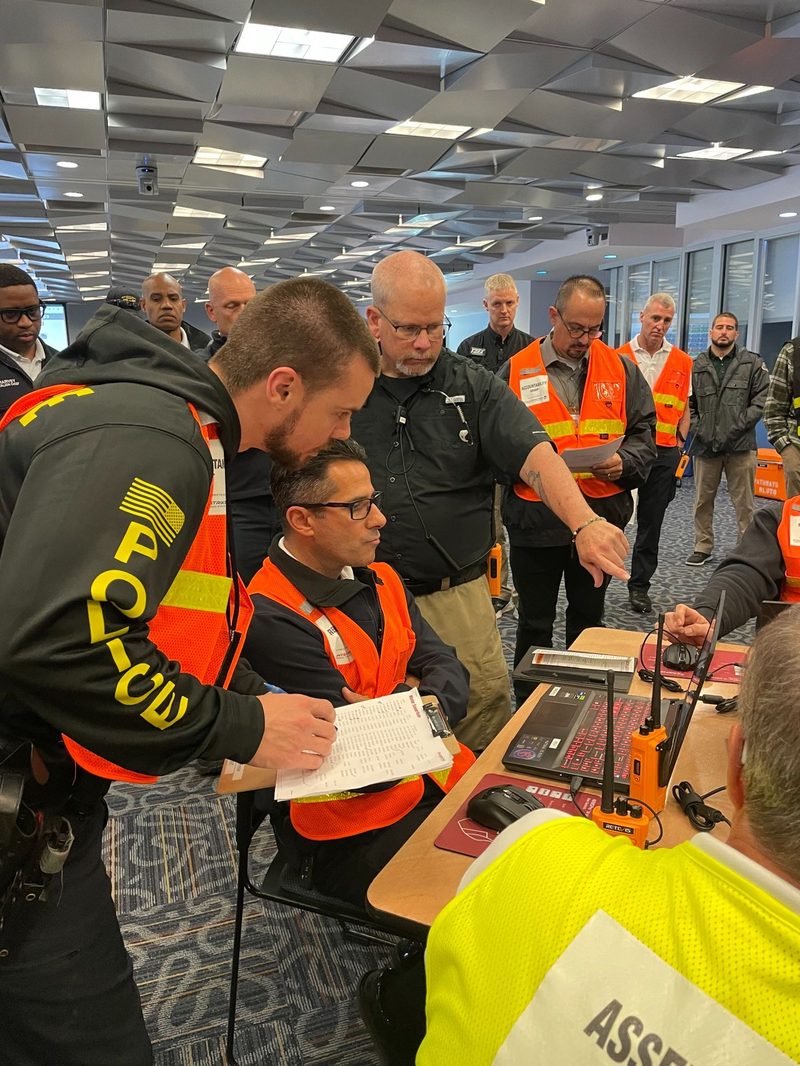
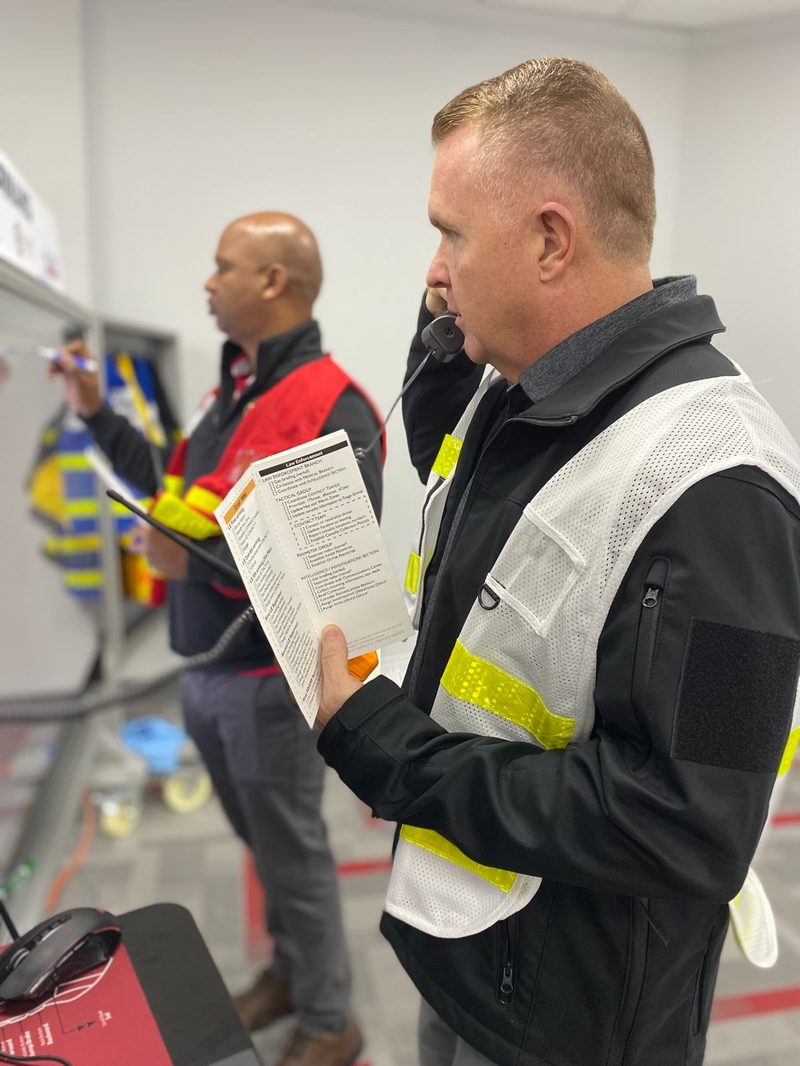
ASIM Advanced is a 24‑hour, 3‑day in‑person course for up to 60 participants across law enforcement, fire/EMS, dispatch, PIO, and emergency management. Using the NIMSPro™ 3D Simulation System, your team runs 10 complete incidents that build from basic active shooter events to complex coordinated attacks with IEDs and barricaded or hostage‑taking attackers. Participants rotate through ASIM Checklist positions, gaining role‑specific experience and system‑wide understanding.
Orientation to the ASIM Checklist, incident profiles, and simulation environment, followed by initial incidents that establish common roles, communications, and priorities.
Run multiple moderate‑complexity incidents that stress‑test unified command, resource deployment, medical operations, communications, and multi‑agency coordination.
Tackle complex coordinated attacks and special‑problem incidents, then complete structured after‑action reviews to capture gaps, strengths, and next steps for your region.
ASIM Advanced puts your people inside realistic, high‑tempo incidents without the risks and costs of full‑scale field exercises. Participants leave with muscle memory for their roles, a shared mental model across disciplines, and a clear picture of how the system performs when everything is on the line.
Responders work in a NIMSPro™ simulation lab that mirrors real‑world radio traffic, timelines, and injects from first 911 call to last patient transport.
Law enforcement, fire, EMS, dispatch, PIO, and emergency management representatives work side by side, building trust and shared expectations across agencies.
Participants rotate through incident commander, operations, medical, staging, perimeter, and other key positions so they understand how each role affects the whole incident.
Each incident ends with a guided after‑action review led by NCIER instructors, connecting decisions and timelines back to the ASIM Checklist and your local policies.
You leave ASIM Advanced with a stronger shared picture of how your system performs under pressure, where the friction points are, and what readiness work needs attention next.
Bring your full team into the same incident before a real one forces the issue.
Hosts provide the venue and up to 60 participants across law enforcement, fire/EMS, dispatch, PIO, and emergency management. NCIER brings the mobile NIMSPro™ simulation lab, instructor team, AV, incident scenarios, and all course materials.
Here’s what happens over the next 1 business day.
Keep an eye out for a call from (407) 490-1300. If you don’t hear from us within 1 business day, call us at (407) 490-1300.
Prefer to talk now? Call (407) 490-1300.
ASIM Advanced is the simulation step that turns ASIM from a classroom concept into proven performance across your full team.
15–20 minutes, no obligation. We’ll help you figure out if hosting ASIM Advanced makes sense for your agency or region.
Schedule a Brief CallWhich part(s) of the course was MOST valuable to you. Please explain why.
Table top excersises.
Which part(s) of the course was LEAST valuable to you? Please explain why.
N/A.
Please provide any other comments or suggestions you have for improving this course.
N/A.
What other training is most important to you now that you have completed this course?
N/A.
Which part(s) of the course was MOST valuable to you. Please explain why.
Being able to participate with other agencies and interact to solve the prohlems. Being able to rotate through different areas and positions of the system. The instructors were all very knowledgable in the subject area and good teachers as well.
Which part(s) of the course was LEAST valuable to you? Please explain why.
None.
Please provide any other comments or suggestions you have for improving this course.
There was a system glitch that caused me to be assigned to the same roll on an ambulance for two days. The instructors caught this and made appropriate corrections.
What other training is most important to you now that you have completed this course?
This needs to be mandatory for all offcidrs in our department.
Which part(s) of the course was MOST valuable to you. Please explain why.
The simulations, b/c they provided experience.
Which part(s) of the course was LEAST valuable to you? Please explain why.
N/a.
Please provide any other comments or suggestions you have for improving this course.
N/a.
What other training is most important to you now that you have completed this course?
Further practical courses.
Which part(s) of the course was MOST valuable to you. Please explain why.
The hands on scenarios were very helpful in seeing how the whole structure worked.
Which part(s) of the course was LEAST valuable to you? Please explain why.
None.
Please provide any other comments or suggestions you have for improving this course.
None.
What other training is most important to you now that you have completed this course?
None.
Which part(s) of the course was MOST valuable to you. Please explain why.
Working together with others and thinking of new or different ideas.
Which part(s) of the course was LEAST valuable to you? Please explain why.
None.
Please provide any other comments or suggestions you have for improving this course.
Priority transporting patients with reds first should be incouraged more.
What other training is most important to you now that you have completed this course?
Relaying the data to my peers.
Which part(s) of the course was MOST valuable to you. Please explain why.
The chance to participate in the various leadership positions during the different scenarios.
Which part(s) of the course was LEAST valuable to you? Please explain why.
Nothing stood out as least valuable.
Please provide any other comments or suggestions you have for improving this course.
As usually what happens in real events communications was difficult, with radio traffic being over ridden. Possibly changing to a different communication system, then those radios issued would work better.
What other training is most important to you now that you have completed this course?
Taking back to my department and present to command staff for implementation of things learned in this class.
Which part(s) of the course was MOST valuable to you. Please explain why.
The practical exercises giving us the opportunity to run an operation.
Which part(s) of the course was LEAST valuable to you? Please explain why.
All was relevant and pertinent.
Please provide any other comments or suggestions you have for improving this course.
This class is a must for ALL levels of law enforcement.
What other training is most important to you now that you have completed this course?
Practical excercises and planning back at my own agency with FIRE , PD and COMMO. Keep it fresh.
Which part(s) of the course was MOST valuable to you. Please explain why.
Participating in different roles.
Which part(s) of the course was LEAST valuable to you? Please explain why.
All were well worth it.
Please provide any other comments or suggestions you have for improving this course.
I thought it was excellent.
What other training is most important to you now that you have completed this course?
Follow on course when it is offered again.
Which part(s) of the course was MOST valuable to you. Please explain why.
The knowledge of the instructors and material provides us some good building blocks to work from in order to improve our SOP's for Active Shooter events.
Which part(s) of the course was LEAST valuable to you? Please explain why.
The technology portion w/ the simulators truly hold you back from learning due to so much effort has to be put into learning the buttons, the program, etc. without much training.
Please provide any other comments or suggestions you have for improving this course.
I ffel that it needs to be more specific to the position you hold within your organization when it comes to the break out sessions/exercises. I wasted a lot of time playing Ambulance Driver and Engine Company personnel when in reality I will never be in one of those positions due to my rank.
What other training is most important to you now that you have completed this course?
Come up w/ better SOP's and training with our LEO's and Mutual Aide partners, thank you.
Which part(s) of the course was MOST valuable to you. Please explain why.
Scenario management not game play.
Which part(s) of the course was LEAST valuable to you? Please explain why.
Game play.
Please provide any other comments or suggestions you have for improving this course.
Course is a little too LEO centric. Not likely that LEOs will set up CCPs and move all aptients to AEP.
What other training is most important to you now that you have completed this course?
Student did not leave a written comment.
*Evaluations are collected from verified course participants and published without editing. Ratings and comments reflect each participant’s individual experience.